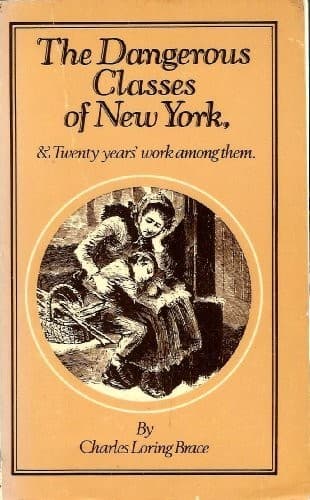
The Dangerous Classes of New York, and Twenty Years' Work Among ThemBrace, Charles Loring
History
The Dangerous Classes of New York, and Twenty Years' Work Among Them
Brace, Charles Loring
Child welfare -- New York (State) -- New York; New York (N.Y.) -- Social conditions; Poor -- New York (State) -- New York
There seemed to be a very considerable class of lads in New York who
bore to the busy, wealthy world about them something of the same
relation which Indians bear to the civilized Western settlers. They had
no settled home, and lived on the outskirts of society, their hand
against every man's pocket, and every man looking on them as natural
enemies; their wits sharpened like those of a savage, and their
principles often no better. Christianity reared its temples over them,
and Civilization was carrying on its great work, while they--a happy
race of little heathens and barbarians--plundered, or frolicked, or led
their roving life, far beneath. Sometimes they seemed to me, like what
the police call them, "street-rats," who gnawed at the foundations of
society, and scampered away when light was brought near them. Their life
was, of course, a painfully hard one. To sleep in boxes, or under
stairways, or in hay-barges on the coldest winter-nights, for a mere
child, was hard enough; but often to have no food, to be kicked and
cuffed by the older ruffians, and shoved about by the police, standing
barefooted and in rags under doorways as the winter-storm raged, and to
know that in all the great city there was not a single door open with
welcome to the little rover--this was harder.
Yet, with all this, a more light-hearted youngster than the street-boy
is not to be found. He is always ready to make fun of his own
sufferings, and to "chaff" others. His face is old from exposure and his
sharp "struggle for existence;" his clothes flutter in the breeze; and
his bare feet peep out from the broken boots. Yet he is merry as a
clown, and always ready for the smallest joke, and quick to take "a
point" or to return a repartee. His views of life are mainly derived
from the more mature opinions of "flash-men," engine-runners,
cock-fighters, pugilists, and pickpockets, whom he occasionally is
permitted to look upon with admiration at some select pot-house; while
his more ideal pictures of the world about him, and, his literary
education, come from the low theatres, to which he is passionately
attached. His morals are, of course, not of a high order, living, as he
does, in a fighting, swearing, stealing, and gambling set. Yet he has
his code; he will not get drunk; he pays his debts to other boys, and
thinks it dishonorable to sell papers on their beat, and, if they come
on his, he administers summary justice by "punching;" he is generous to
a fault, and will always divide his last sixpence with a poorer boy.
"Life is a strife" with him, and money its reward; and, as bankruptcy
means to the street-boy a night on the door-steps without supper, he is
sharp and reckless, if he can only earn or get enough to keep him above
water. His temptations are, to cheat, steal, and lie. His religion is
vague. One boy, who told me he "didn't live nowhere," who had never
heard of Christ, said he had heard of God, and the boys thought it "kind
Public-domain text, read in full here on John Shaqi.
Reviews
Reviews
No reviews yet
Be the first to share your thoughts on this work.
Elsewhere in the archive
Join the Discussion
Join the discussion
Sign in to leave a comment or review.
Sign InorCreate an account