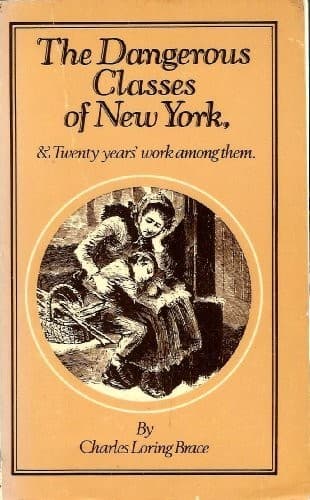
The Dangerous Classes of New York, and Twenty Years' Work Among ThemBrace, Charles Loring
History
The Dangerous Classes of New York, and Twenty Years' Work Among Them
Brace, Charles Loring
Child welfare -- New York (State) -- New York; New York (N.Y.) -- Social conditions; Poor -- New York (State) -- New York
"Yet it is cheering--it cheered me even in that squalid hole--that the
children are so much superior to their parents. It needs time for vice
and beggary and filth to degrade childhood. God has given every fresh
human soul something which rises above its surroundings, and which even
want and vice do not wear away. For the old poor, for the sensual who
have steeped themselves in crime, for the drunkard, the thief, the
prostitute who have run a long course, let those heroically work who
will. Yet, noble as is the effort, one's experience of human nature is
obliged to confess, the fruits will be very few. The old heart of man is
a hard thing to change. In any comprehensive view, the only hopeful
reform through society must begin with childhood, basing itself on a
change of circumstances and on religious influences."
The average expense of a school of this nature, with one hundred
scholars and two salaried teachers, where a cheap meal is supplied, and
garments and shoes are earned by the scholars, we reckon usually at
$1,500, or at $15 per head annually for each scholar.
CHAPTER XIII.
THE GERMAN RAG-PICKERS.
Our next great effort was among the Germans. On the eastern side of the
city is a vast population of German laborers, mechanics, and
shop-keepers. Among them, also, are numbers of exceedingly poor people,
who live by gathering rags and bones.
I used at that time to explore these singular settlements, filled with
the poor peasantry of the "Fatherland," and being familiar with the
German _patois,_ I had many cheery conversations with these honest
people, who had drifted into places so different from their
mountain-homes. In fact, it used to convey to me a strange contrast, the
dirty yards piled with bones and flaunting with rags, and the air
smelling of carrion; while the accents reminded of the glaciers of the
Bavarian Alps or the fresh breezes and wild scenes of the Harz. The poor
people felt the contrast terribly, and their children most of all.
From ignorance of the language and the necessity of working at their
street-trades, they did not attend our schools, and seldom entered a
church. They were growing up without either religion or education. Yet
they were a much more honest and hopeful class than the Irish. There
seemed always remaining in them something of the good old German
_Biederkeit,_ or solidity. One could depend on the children if they were
put in places of trust, and in school they seemed to grasp knowledge
with much more tenacity and vigor. The young girls, however, coming from
a similar low class were weaker in virtue than the Irish.
The number of the Germans in the poor quarters may be somewhat measured
by the population of the Wards which they inhabited. The Eleventh Ward
at that time (1854) was reckoned to contain 50,000 inhabitants; at
present (1870) it contains 64,372, and the Sixteenth Ward, another
strong German district, has 99,375.
Public-domain text, read in full here on John Shaqi.
Reviews
Reviews
No reviews yet
Be the first to share your thoughts on this work.
Elsewhere in the archive
Join the Discussion
Join the discussion
Sign in to leave a comment or review.
Sign InorCreate an account