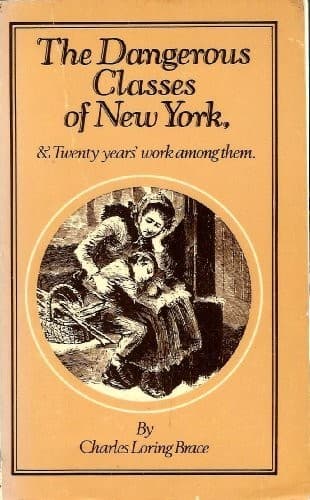
The Dangerous Classes of New York, and Twenty Years' Work Among ThemBrace, Charles Loring
History
The Dangerous Classes of New York, and Twenty Years' Work Among Them
Brace, Charles Loring
Child welfare -- New York (State) -- New York; New York (N.Y.) -- Social conditions; Poor -- New York (State) -- New York
In 1859, a subscription of about $1,000 was obtained from them, and the
School was enlarged and made still more attractive, so as to reach the
young working German girls in the evening. At this time a young lady of
high culture, from one of the prominent intellectual families of New
England, offered herself for this difficult task, and she was placed at
the head of the School. For two years she labored unceasingly for this
wild, uncontrolled class, being present every evening in the school, and
bringing all her education and earnestness of character to bear upon
them. They never forgot her, and she left an indelible impression on
these children, and aided in saving them from the temptations which have
ruined so many of their companions.
Our German patrons gradually left us, and it was only in 1870 that their
assistance was secured again for a charity which was saving so many
thousand children of their countrymen.
The School is now held at No. 272 Second Street, and contains some four
hundred children.
"DUTCH HILL" AND THE SWILL-GATHERERS.
On the eastern side of the city, in the neighborhood of Fortieth Street,
is a village of squatters, which enjoys the title of "Dutch Hill." The
inhabitants are not, however, "Dutch," but mainly poor Irish, who have
taken temporary possession of unused sites on a hill, and have erected
shanties which serve at once for pig-pens, hen-coops, bed-rooms, and
living-rooms. They enjoy the privilege of squatters in having no rent to
pay; but they are exposed to the penalty of being at any moment turned
out from their dens, and losing land and house at once. Usually they
remain while the quarrymen who are opening streets almost undermine
their shanties, and then if the buildings are not blown away, they pull
them down and pack them away like tents to another dwelling-place.
The village is filled with snarling dogs, which aid in drawing the swill
or coal carts, for the children are mainly employed in collecting swill
and picking coals through the streets.
The shanty family are never quite so poor as the tenement-house family;
as they have no rent to pay. But the filth and wretchedness in which
they sometimes live are beyond description.
Public-domain text, read in full here on John Shaqi.
Reviews
Reviews
No reviews yet
Be the first to share your thoughts on this work.
Elsewhere in the archive
Join the Discussion
Join the discussion
Sign in to leave a comment or review.
Sign InorCreate an account