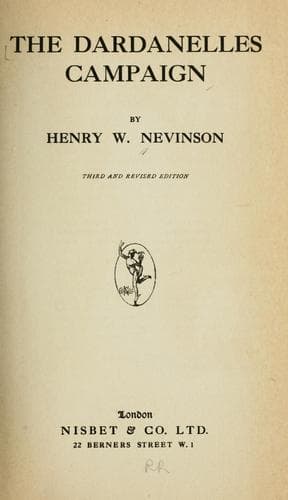
World War, 1914-1918 -- Campaigns -- Turkey -- Gallipoli Peninsula
The Indians stood the climate far better than the British or
Australians, either as vegetarians or as habituated to the sun and
protected by their colour, whereas the Australians and many of the
British sought to avoid heat by going naked, and so exposed their white
skins to the unaccustomed and baleful rays. Life in the bazaar or
jungle had also rendered Indians immune to diseases against which our
civilisation stands unprotected, and flies did not pursue the cleanly
food of Hindus and Sikhs with the same persistent avidity. If some
of the British troops upon the Peninsula had been exchanged for the
Indian troops serving in France and Flanders, both armies would have
gained in health. But perhaps a greater cause of disease than sun or
flies or infection was the monotony of the diet, as mentioned before.
Sir Ian’s appeals for canteens remained unheard till August 30, when a
canteen-ship actually appeared at Anzac. Deputed purchasers from every
unit hurried down to buy. Bursting with money, they stood in queues,
but none received more than one-sixth of what he asked, and, as in
a starving town, scarcity laughed at cash. But after the arrival of
that one shipload of variety, the numbers of sick suddenly fell, and
ultimately ten shiploads came. Allowance must also be made for the
arrival of the 2nd Australian Division, which raised the average of
health, until the infection spread among its members also; and that was
soon.
But more disheartening even than inactivity or disease was the
disappearance of the dead and wounded. During August some 40,000--about
one-third of the whole force--had gone. Entirely sufficient provision
had now been made for the wounded alike in the largely increased
number of hospital ships running to Alexandria, and in the hospital
camps established near Suvla A Beach (too near the Hill 10 batteries)
and on two positions along the Suvla promontory (also disturbed by
shells owing to the proximity of store depôts, landing-places, and
Corps Headquarters); at well-sheltered points along the Ocean Beach,
near Anzac; upon the flats at the end of Kephalos Bay, in Imbros; and
especially on the breezy rising ground overlooking Mudros harbour on
the opposite side to Mudros town. The dead either lay beyond reach,
gradually shrinking to dust on “No Man’s Land,” or were buried in
carefully tended little cemeteries, their graves marked with wooden
crosses and decorated with shell-cases or white stones arranged in
patterns. Brief as regret and lamentation must be in war, it is
melancholy to return to familiar dug-outs and find that the familiar
occupants have gone, leaving possessions which they will not need
again, and perhaps a written notice to warn off intruders from the
deserted habitation. The sense of loss was especially poignant at
Anzac, where, united by the bonds of adventure and nationality, the men
had lived as in a crowded community of fellowship.
[Sidenote: DISADVANTAGES OF NEW DRAFTS]
Public-domain text, read in full here on John Shaqi.
Reviews
Reviews
No reviews yet
Be the first to share your thoughts on this work.
Elsewhere in the archive
Join the Discussion
Join the discussion
Sign in to leave a comment or review.
Sign InorCreate an account