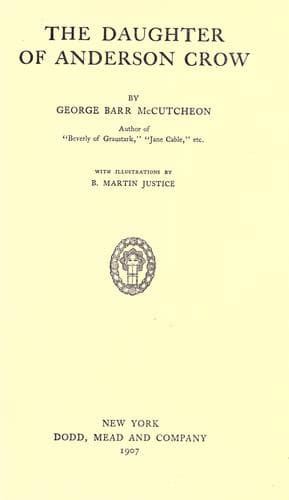
The Daughter of Anderson CrowMcCutcheon, George Barr
General
The Daughter of Anderson Crow
McCutcheon, George Barr
City and town life -- Fiction; Foundlings -- Fiction; New York (State) -- Fiction
The days came when Bonner could walk about with his cane, and he was not
slow to avail himself of the privilege this afforded. It meant enjoyable
strolls with Rosalie, and it meant the elevation of his spirits to such
heights that the skies formed no bounds for them. The town was not slow
to draw conclusions. Every one said it would be a "match." It was
certain that the interesting Boston man had acquired a clear field.
Tinkletown's beaux gave up in despair and dropped out of the contest
with the hope that complete recovery from his injuries might not only
banish Bonner from the village, but also from the thoughts of Rosalie
Gray. Most of the young men took their medicine philosophically. They
had known from the first that their chances were small. Blootch Peabody
and Ed Higgins, because of the personal rivalry between themselves,
hoped on and on and grew more bitter between themselves, instead of
toward Bonner.
[Illustration: "'I beg your pardon,' he said humbly"]
Anderson Crow and Eva were delighted and the Misses Crow, after futile
efforts to interest the young man in their own wares, fell in with the
old folks and exuberantly whispered to the world that "it would be
perfectly glorious." Roscoe was not so charitable. He was soundly
disgusted with the thought of losing his friend Bonner in the hated
bonds of matrimony. From his juvenile point of view, it was a fate
that a good fellow like Bonner did not deserve. Even Rosalie was not
good enough for him, so he told Bud Long; but Bud, who had worshipped
Rosalie with a hopeless devotion through most of his short life, took
strong though sheepish exceptions to the remark. It seemed quite settled
in the minds of every one but Bonner and Rosalie themselves. They went
along evenly, happily, perhaps dreamily, letting the present and the
future take care of themselves as best they could, making mountains of
the past--mountains so high and sheer that they could not be surmounted
in retreat.
Bonner was helplessly in love--so much so, indeed, that in the face of
it, he lost the courage that had carried him through trivial affairs of
the past, and left him floundering vaguely in seas that looked old and
yet were new. Hourly, he sought for the first sign of love in her eyes,
for the first touch of sentiment; but if there was a point of weakness
in her defence, it was not revealed to the hungry perception of the
would-be conqueror. And so they drifted on through the February chill,
that seemed warm to them, through the light hours and the dark ones,
quickly and surely to the day which was to call him cured of one ill and
yet sorely afflicted by another.
Public-domain text, read in full here on John Shaqi.
Reviews
Reviews
No reviews yet
Be the first to share your thoughts on this work.
Elsewhere in the archive
Join the Discussion
Join the discussion
Sign in to leave a comment or review.
Sign InorCreate an account