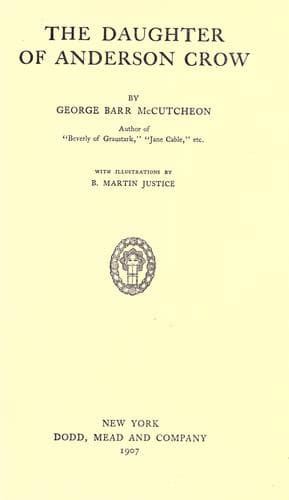
The Daughter of Anderson CrowMcCutcheon, George Barr
General
The Daughter of Anderson Crow
McCutcheon, George Barr
City and town life -- Fiction; Foundlings -- Fiction; New York (State) -- Fiction
"Don't, please don't, Wicker," she said softly, firmly. Her hand touched
his arm for an instant. "You will understand, won't you? Please don't!"
There was a world of meaning in it.
His heart turned cold as ice, the blood left his face. He understood.
She did not love him.
"Yes," he said, his voice dead and hoarse, "I think I understand,
Rosalie. I have taken too much for granted, fool that I am. Bah! The
egotism of a fool!"
"You must not speak like that," she said, her face contracted by pain
and pity. "You are the most wonderful man I've ever known--the best and
the truest. But--" and she paused, with a wan, drear smile on her lips.
"I understand," he interrupted. "Don't say it. I want to think that some
day you will feel like saying something else, and I want to hope,
Rosalie, that it won't always be like this. Let us talk about something
else." But neither cared to speak for what seemed an hour. They were in
sight of home before the stony silence was broken. "I may come over from
Bonner Place to see you?" he asked at last. He was to cross the river
the next day for a stay of a week or two at his uncle's place.
"Yes--often, Wicker. I shall want to see you every day. Yes, every day;
I'm sure of it," she said wistfully, a hungry look in her eyes that he
did not see, for he was staring straight ahead. Had he seen that look or
caught the true tone in her voice, the world might not have looked so
dark to him. When he did look at her again, her face was calm almost to
sereneness.
"And you will come to Boston in June just the same?"
"If your sister and--and your mother still want me to come."
[Illustration: "'I think I understand, Rosalie'"]
She was thinking of herself, the nameless one, in the house of his
people; she was thinking of the doubts, the speculations--even the fears
that would form the background of her welcome in that proud house. No
longer was Rosalie Gray regarding herself as the happy, careless
foster-child of Anderson Crow; she was seeing herself only as the
castaway, the unwanted, and the world was growing bitter for her. But
Bonner was blind to all this; he could not, should not know.
"You know they want you to come. Why do you say that?" he asked quickly,
a strange, dim perspective rising before him for an instant, only to
fade away before it could be analysed.
"One always says that," she replied with a smile. "It is the penalty of
being invited. Your sister has written the dearest letter to me, and I
have answered it. We love one another, she and I."
"Rosalie, I am going to write to you," said he suddenly; "you will
answer?"
"Yes," she told him simply. His heart quickened, but faltered, and was
lost. "I had a long letter from Elsie Banks to-day," she went on with an
indifference that chilled.
"Oh," he said; "she is your friend who was or is to marry Tom Reddon, I
believe. I knew him at Harvard. Tell me, are they married?"
Public-domain text, read in full here on John Shaqi.
Reviews
Reviews
No reviews yet
Be the first to share your thoughts on this work.
Elsewhere in the archive
Join the Discussion
Join the discussion
Sign in to leave a comment or review.
Sign InorCreate an account