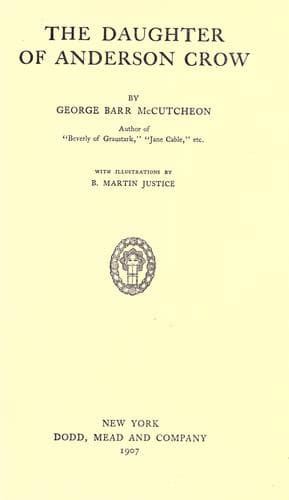
The Daughter of Anderson CrowMcCutcheon, George Barr
General
The Daughter of Anderson Crow
McCutcheon, George Barr
City and town life -- Fiction; Foundlings -- Fiction; New York (State) -- Fiction
There was a letter at home for her from Edith Bonner. It brought the
news that Wicker was going South to recuperate. His system had "gone
off" since the accident, and the March winds were driving him away
temporarily. Rosalie's heart ached that night, and there was a still,
cold dread in its depths that drove sleep away. He had not written to
her, and she had begun to fear that their month had been a trifle to
him, after all. Now she was troubled and grieved that she should have
entertained the fear. Edith went on to say that her brother had seen the
New York detective, who was still hopelessly in the dark, but struggling
on in the belief that chance would open the way for him.
Rosalie, strive as she would to prevent it, grew pale and the roundness
left her cheek as the weeks went by. Her every thought was with the man
who had gone to the Southland. She loved him as she loved life, but she
could not confess to him then or thereafter unless Providence made clear
the purity of her birth to her and to all the world. When finally there
came to her a long, friendly, even dignified letter from the far South,
the roses began to struggle back to her cheeks and the warmth to her
heart. Her response brought a prompt answer from him, and the roses grew
faster than the spring itself. Friendship, sweet and loyal, marked every
word that passed between them, but there was a dear world in each
epistle--for her, at least, a world of comfort and hope. She was
praying, hungering, longing for June to come--sweet June and its tender
touch--June with its bitter-sweet and sun clouds. Now she was forgetting
the wish which had been expressed to Anderson Crow on the drive home
from Boggs City. In its place grew the fierce hope that the once
despised detective might clear away the mystery and give her the right
to stand among others without shame and despair.
"Hear from Wick purty reg'lar, don't you, Rosalie?" asked Anderson
wickedly, one night while Blootch was there. The suitor moved uneasily,
and Rosalie shot a reproachful glance at Anderson, a glance full of
mischief as well.
"He writes occasionally, daddy."
"I didn't know you corresponded reg'larly," said Blootch.
"I did not say regularly, Blucher."
"He writes sweet things to beat the band, I bet," said Blootch with a
disdain he did not feel.
"What a good guesser you are!" she cried tormentingly.
"Well, I guess I'll be goin'," exploded Blootch wrathfully; "it's
gittin' late."
"He won't sleep much to-night," said Anderson, with a twinkle in his
eye, as the gate slammed viciously behind the caller. "Say, Rosalie,
there's somethin' been fidgetin' me fer quite a while. I'll blurt it
right out an' have it over with. Air you in love with Wick Bonner?"
Public-domain text, read in full here on John Shaqi.
Reviews
Reviews
No reviews yet
Be the first to share your thoughts on this work.
Elsewhere in the archive
Join the Discussion
Join the discussion
Sign in to leave a comment or review.
Sign InorCreate an account