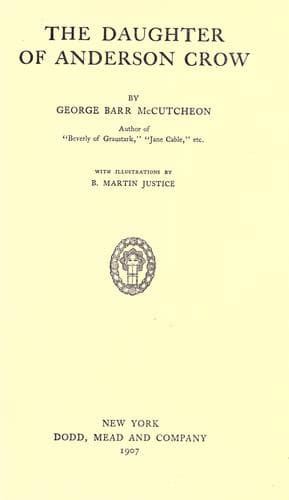
The Daughter of Anderson CrowMcCutcheon, George Barr
General
The Daughter of Anderson Crow
McCutcheon, George Barr
City and town life -- Fiction; Foundlings -- Fiction; New York (State) -- Fiction
"Have you considered? Have you thought? I have, a thousand times, a
thousand bitter thoughts. I cannot, I will not be your--your wife,
Wicker, until--"
In vain he argued, pleaded, commanded. She was firm and she felt she was
right if not just. Underneath it all lurked the fear, the dreadful fear
that she may have been a child of love, the illegitimate offspring of
passion. It was the weight that crushed her almost to lifelessness; it
was the bar sinister.
"No, Wicker, I mean it," she said in the end resolutely. "Not until I
can give you a name in exchange for your own."
"Your name shall one day be Bonner if I have to wreck the social system
of the whole universe to uncover another one for you."
The automobile had been standing, by some extraordinary chance, in the
cool shade of a great oak for ten minutes or more, but it was a wise,
discreet old oak.
CHAPTER XXX
The Hemisphere Train Robbery
Anderson Crow lived at the extreme south end of Tinkletown's principal
thoroughfare. The "calaboose" was situated at the far end of Main
Street, at least half a mile separating the home of the law and the home
of the lawless. Marshal Crow's innate love for the spectacular alone
explains the unneighbourliness of the two establishments. He felt an
inward glory in riding or walking the full length of the street, and he
certainly had no reason to suspect the populace of disregarding the
outward glory he presented.
The original plan of the merchantry comprehended the erection of the
jail in close proximity to the home of its chief official, but Mr. Crow
put his foot flatly and ponderously upon the scheme. With the dignity
which made him noticeable, he said he'd "be doggoned ef he wanted to
have people come to his own dooryard to be arrested." By which, it may
be inferred, that he expected the evil-doer to choose his own arresting
place.
Mr. and Mrs. Crow were becoming thrifty, in view of the prospect that
confronted them, to wit: The possible marriage of Rosalie and the
cutting off of the yearly payments. As she was to be absent for a full
month or more, Anderson conceived the idea of advertising for a lodger
and boarder. By turning Roscoe out of his bed, they obtained a spare
room that looked down upon the peony beds beyond the side "portico."
Mr. Crow was lazily twisting his meagre chin whiskers one morning soon
after Rosalie's departure. He was leaning against the town pump in front
of the post-office, the sun glancing impotently off the bright badge on
the lapel of his alpaca coat. A stranger came forth from the post-office
and approached the marshal.
"Is this Mr. Crow?" he asked, with considerable deference.
"It is, sir."
"They tell me you take lodgers."
"Depends."
"My name is Gregory, Andrew Gregory, and I am here to canvass the
neighbourhood in the interest of the Human Life Insurance Company of
Penobscot. If you need references, I can procure them from New York or
Boston."
Public-domain text, read in full here on John Shaqi.
Reviews
Reviews
No reviews yet
Be the first to share your thoughts on this work.
Elsewhere in the archive
Join the Discussion
Join the discussion
Sign in to leave a comment or review.
Sign InorCreate an account