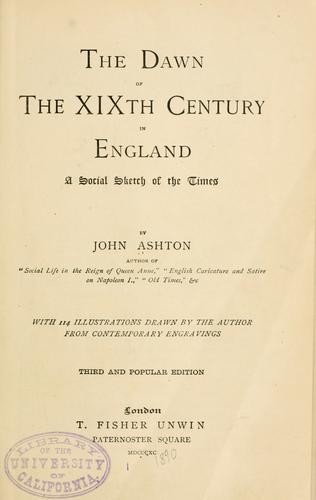
The Dawn of the XIXth Century in England: A social sketch of the timesAshton, John
History
The Dawn of the XIXth Century in England: A social sketch of the times
Ashton, John
England -- Social life and customs -- 19th century
There was yet another water supply, which was obtained from pumps and
springs, and which afforded a livelihood to many hard-working, and
industrious, men. Perhaps, one of the last places in the vicinity of
London thus supplied, was Hampstead—a neighbourhood noted for springs,
where the water used to be thus fetched from the “Conduit Meads” and
other places, and retailed at 1d. or 2d. per bucket, according to
distance. This only ceased when the Midland Railway ran a tunnel
underneath the spring, and destroyed it.
[Illustration: DRINKING WATER SUPPLY—1802.]
The water supply from the Thames, and New River, it must be remembered,
was only turned on three times a week.
The Streets of London in 1804 are thus contemporaneously described:
“It may well excite our admiration to go from Charing Cross to the
Exchange, and pass a double row of carriages, one coming, another
going, with scarcely an intermission. Yet, when we recollect the
numerous causes that put so many things, and persons, in motion, we
may admire, but must own it was to be expected. Not only are the
streets filled with carriages, but with foot passengers; so that the
great thoroughfares of London appear like a moving multitude, or a
daily fair. To this deception the endless shops lend their aid; it is,
indeed, the remark of strangers in general, that London is a continual
fair. The display made by the traders, the numerous wares they have to
sell, and the continual crowd that is passing and re-passing, forcibly
contribute to the delusion.”
Yet the streets were narrow, or at least we think them so, for we have
always to widen them for the perpetually increasing traffic; and the
shops could in no ways at all compare with ours. Small panes of glass,
and small windows were not calculated to show off the traders’ wares
to advantage. Even the contemporary guide-books, can give no shops of
particular excellence—except those which sold keramic ware. In this,
that particular portion of the century was pre-eminent, and one longs
to have had a stroll, looking in first at Wedgwood’s warehouse in
St. James’s Square, then at the Worcester China Warehouse, Coventry
Street; from thence to the show rooms of Derby china, in Henrietta
Street, Covent Garden; and finishing up with Spode’s exposition of
Staffordshire ware, in Portugal Street.
Public-domain text, read in full here on John Shaqi.
Reviews
Reviews
No reviews yet
Be the first to share your thoughts on this work.
Elsewhere in the archive
Join the Discussion
Join the discussion
Sign in to leave a comment or review.
Sign InorCreate an account