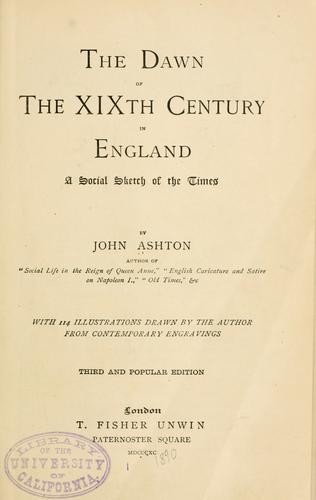
The Dawn of the XIXth Century in England: A social sketch of the timesAshton, John
History
The Dawn of the XIXth Century in England: A social sketch of the times
Ashton, John
England -- Social life and customs -- 19th century
Thus we see that the paternal government of that day did all they could
to find food for the hungry; and it is somewhat curious to note the
commencement of a trade for food, with two countries like India and
the United States of America. Still more did the Government attempt
to alleviate the distress by passing an Act (41 Geo. III. c. 16),
forbidding the manufacture of fine bread, and enacting that all bread
should contain the whole meal—_i.e._, all the bran, &c.—and be what
we term “brown bread.” Indeed the Act was called, popularly, “The Brown
Bread Bill.” It came into force on the 16th of January, 1801, a date
which was afterwards extended to the 31st of January, but did not last
long; its repeal receiving the Royal Assent on the 26th of February of
the same year.
So also the authorities did good service in prosecuting bakers for
light weight; and the law punished them heavily. I will only make
one quotation—_Morning Post_, February 5, 1801. “PUBLIC OFFICE, BOW
STREET. LIGHT BREAD. Several complaints having been made against a
baker in the neighbourhood of Bloomsbury, for selling bread short of
weight, he was, yesterday, summoned on two informations; the one for
selling a quartern loaf deficient of its proper weight eight ounces,
and the other for a quartern loaf wanting four ounces. A warrant was
also issued to weigh all the bread in his shop, when 29 quartern loaves
were seized, which wanted, together, 58 ounces, of their proper weight;
the light bread was brought to the office, and the defendant appeared
to answer the charges. The parties were sworn as to the purchase of
the first two loaves, which being proved, and the loaves being weighed
in the presence of the Magistrates, the defendant was convicted in the
full penalty of five shillings per ounce for the twelve ounces they
were deficient; and, Mr. Ford observing that as the parties complaining
were entitled to one moiety of the penalty, he could not with justice
remit any part of it.
“Respecting the other 29 loaves, as it was the report of the officers
who executed the warrant, that there were a considerable number more
found in his shop that were of full weight, it was the opinion of
him, and the other Magistrates then present, that the fine should be
mitigated to 2s. per ounce, amounting to £5 16s., which the defendant
was, accordingly, obliged to pay, and the 29 loaves, which, of course,
were forfeited, Mr. Ford ordered to be distributed to the poor.
“A search warrant was also executed at the shop of a baker near Drury
Lane, against whom an information had also been laid for selling light
bread; but, it being near three o’clock in the afternoon when the
officers went to the shop, very little bread remained, out of which,
however, they found eight quarterns, three half quarterns, and four
twopenny loaves, short of weight 28 ounces, and on which the baker was
adjudged to pay 2s. per ounce, and the bread was disposed of in the
same manner as the other.”
Public-domain text, read in full here on John Shaqi.
Reviews
Reviews
No reviews yet
Be the first to share your thoughts on this work.
Elsewhere in the archive
Join the Discussion
Join the discussion
Sign in to leave a comment or review.
Sign InorCreate an account