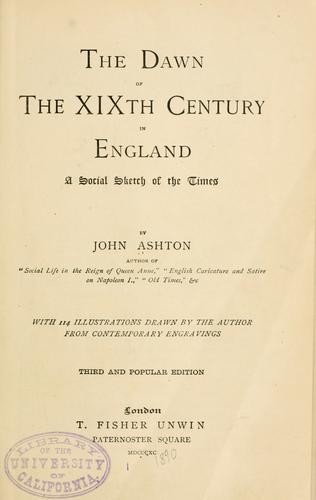
The Dawn of the XIXth Century in England: A social sketch of the timesAshton, John
History
The Dawn of the XIXth Century in England: A social sketch of the times
Ashton, John
England -- Social life and customs -- 19th century
But, with the treaty of peace with France came comparative plenty. The
French were keen enough to, at once, take advantage of the resumption
of friendly relations; and, knowing that an era of cheaper food was
to be inaugurated, prices fell rapidly here. For instance, no sooner
did the news of peace reach Ireland, than the price of pork fell, in
some markets from 63s. to 30s. per cwt.; and beef dropped to 33s. 6d.
or 30s. 6d. per cwt. Butter, and other farm produce had proportionable
reductions. In London, one shopkeeper somewhat whimsically notified
the change. At the time of illumination for the peace, he displayed a
transparency, on one side of which was a quartern loaf, under which
were the words, “_I am coming down_,” and by its side appeared a pot of
porter, which rejoined, “_So am I_.”
When the pioneer boat, loaded with provisions from France, arrived at
Portsmouth, the authorities were at a loss as to what to do with her;
so she was detained until an order could be received permitting her to
trade and depart within 24 hours. Her cargo was sold out at once, and
no wonder, for she sold pigs at 16s. each, turkeys 2s. 6d. each, and
fowls 2s. a couple, whilst eggs were going at 1s. 6d. a score.
Whilst on this subject, mention may be made of the kind of provision
made for the men’s feeding, otherwise than at home. The Hotel proper,
as we know it, was but in its infancy; and, as far as I can gather,
there were but some fifteen hotels in London. This does not, of course,
include the large coaching inns, which made up beds, because they
catered for a fleeting population; nor does it take cognizance of the
coffee houses, many of which made up beds, especially for visitors from
various counties, where they might possibly meet with friends, or hear
the last news about them, and see the county newspaper; whilst all,
without exception, and most of the taverns, supplied their customers
with dinners, and other food—in fact, they acted as _victuallers_, and
not as the keepers of _drinkeries_, as now. There were, besides, many
of the cheaper class of eating houses, called _cook shops_, scattered
over every part of the town, at which a plentiful dinner might be
obtained at, from a shilling, to eighteenpence. In addition, there were
very many _à la mode_ beef houses, and soup shops, so that every taste,
and purse, was consulted.
Before closing these notes on feeding, early in the century, I must
chronicle a “little dinner.” _Morning Post_, July 26, 1800: “At a
village in Cheshire, last year, three clergymen, after dinner, ate
fourteen quarts of nuts, and, during their sitting, drank six bottles
of port wine, and NO other liquor!”
[Illustration]
[Illustration]
CHAPTER XXX.
Men’s dress—the “Jean de Bry” coat—Short coats fashionable at
watering-places—“All Bond Street trembled as he strode”—Rules for
the behaviour of a “Bond Street Lounger.”
Public-domain text, read in full here on John Shaqi.
Reviews
Reviews
No reviews yet
Be the first to share your thoughts on this work.
Elsewhere in the archive
Join the Discussion
Join the discussion
Sign in to leave a comment or review.
Sign InorCreate an account