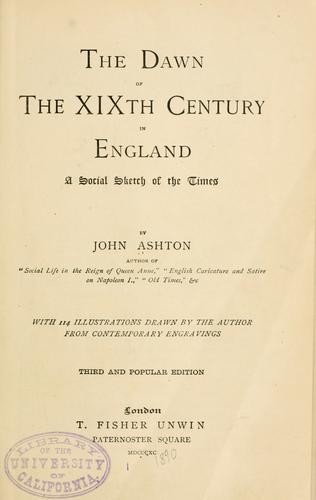
The Dawn of the XIXth Century in England: A social sketch of the timesAshton, John
History
The Dawn of the XIXth Century in England: A social sketch of the times
Ashton, John
England -- Social life and customs -- 19th century
As will be seen, they wore powder, but this curious fashion was on its
last legs—the _Crops_, or advanced Whigs, having given it its death
blow; still, it struggled on for some years yet. There is a little
story told in the _Morning Herald_ of the 20th of June, 1804, which
will bear reproduction: “The following conversation occurred on Monday
last, in the Gallery of the House of Commons. A gentleman, very much
powdered, happened to sit before another who did not wear any. During
the course of the debate the son of _powder_ in front, frequently
annoyed, by his nodding, or rather his _noddle_, his neighbour in the
rear, for which he apologized, as often as any notice was taken of
it. At last, the influence of Morpheus became so powerful, that the
rear rank man found his arm perfectly painted with _powder_, in such
a manner as to produce some _ignition_ in his temper, and repel his
annoyer with a little more _spunk_[47] than he showed on any of the
former occasions. This being resented, the other presented his arm,
and said, ‘Sir, you should not be angry; for, if I wished for such an
ornament as this, I should, this morning, have left that office to
my hair-dresser. I am a man of such independence that I would not,
willingly, be indebted to you for a single _meal_, and here you have
forced on me a bushel. If I had been your greatest enemy, you could do
nothing more severe, than to _pulverize_ me; and, as I have given you
no intentional offence, I must beg of you, in future, not to _dust my
jacket_.’ This sally had all the effect for which it was intended, and,
instead of exchanging cards, the affair ended, like some senatorial
speeches, in a _laugh_.”
As all the members of the family, including the domestics had to be
powdered, most houses of any pretension had a small room set apart for
the performance, called “the powdering room,” or closet, where the
person to be operated upon went behind two curtains, and, by putting
the head between the two, the body was screened from the powder, and
the head received its due quantity, without injury to the clothes.
Still, all the world was not rich, and, therefore, with some, economy
in clothing was a necessity. As is usual, when a want appears,
it is met; and in this case it certainly was, in a (to us) novel
manner—_Morning Post_ January 12, 1805: “INTERESTING to the PUBLIC.
W Welsford, Tailor, No. 142, Bishopsgate Street, respectfully informs
the Public, that he continues to pursue the plan, originally adopted by
him, six years since, of SUPPLYING CLOTHES, on the following terms:—
Four Suits of Superfine Clothes, the old
Suits to be returned, in one year £16 0 0
Five Suits 18 18 0
Six Suits 21 10 0
“Those Gentlemen who should not prefer the above Contract, may be
supplied at the undermentioned reduced price:
Public-domain text, read in full here on John Shaqi.
Reviews
Reviews
No reviews yet
Be the first to share your thoughts on this work.
Elsewhere in the archive
Join the Discussion
Join the discussion
Sign in to leave a comment or review.
Sign InorCreate an account