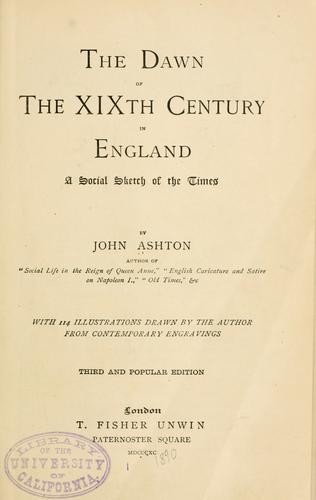
The Dawn of the XIXth Century in England: A social sketch of the timesAshton, John
History
The Dawn of the XIXth Century in England: A social sketch of the times
Ashton, John
England -- Social life and customs -- 19th century
We have seen it recommended to the Bond Street Lounger that it was
absolutely necessary for him to have an eye-glass suspended from his
button-hole; and the same fashion is mentioned in the _Morning Post_,
August 28, 1806: “The town has been long amused with the _quizzing
glasses_ of our modern fops, happily ridiculed by a door-key in
O’Keefe’s whimsical farce of _The Farmer_. A Buck has lately made his
appearance in Bond Street, daily, between two and four o’clock, with
_a Telescope_, which he occasionally applies to his eye, as he has a
glimpse of some object passing on the other side of the street, worth
_peeping_ at. At the present season, we cannot but recommend this
practice to our fashionable readers, who remain in the Metropolis. It
indicates friendship, as it shows a disposition to _regard_ those who
are at a _distance_.”
[Illustration: ORIGINALS. A HINT TO THE BON TON.]
There have been, in all ages of fashion, some who outvied the common
herd in eccentricity of costume; and the early nineteenth century was
no exception to the rule. It is true that it had not, in the time of
which I write, arisen to the dignity of a “pea-green Haines;” but
still, it could show its “Green Man.” “BRIGHTON, September 25, 1806.
Among the personages attracting, here, public notice, is an original,
or _would-be_ original, generally known by the appellation of ‘the
Green Man.’ He is dressed in green pantaloons, green waistcoat,
green frock, green cravat; and his ears, whiskers, eyebrows, and
chin, are better powdered than his head, which is, however, covered
with flour. He eats nothing but green fruits and vegetables; has his
rooms painted green, and furnished with a green sofa, green chairs,
green tables, green bed, and green curtains. His gig, his livery, his
portmanteau, his gloves, and his whip, are all green. With a green
silk handkerchief in his hand and a large watch chain, with green seals
fastened to the green buttons of his green waistcoat, he parades every
day on the Steyne, and in the libraries, erect like a statue, walking,
or, rather, moving to music, smiling and singing, as well contented
with his own dear self, as well as all those round him, who are not
few.” That he had money was evident, for his green food, including,
as it did, choice fruit, would sometimes cost him a guinea a day;
besides which, he was seen at every place of amusement, and spent his
money lavishly. Eventually, he turned out to be a lunatic, and, after
throwing himself out of windows, and off a cliff, he was taken care of.
The two preceding illustrations are manifest exaggerations of costume;
but the germ of truth which supplies the satire is there; and, with
them, the men’s dress of this period is closed.
[Illustration]
[Illustration]
CHAPTER XXXII.
Ladies’ dress—French costume—Madame Recamier—The classical
style—“Progress of the toilet”—False hair—Hair-dresser’s
advertisement—The Royal Family and dress—Curiosities of costume.
Public-domain text, read in full here on John Shaqi.
Reviews
Reviews
No reviews yet
Be the first to share your thoughts on this work.
Elsewhere in the archive
Join the Discussion
Join the discussion
Sign in to leave a comment or review.
Sign InorCreate an account