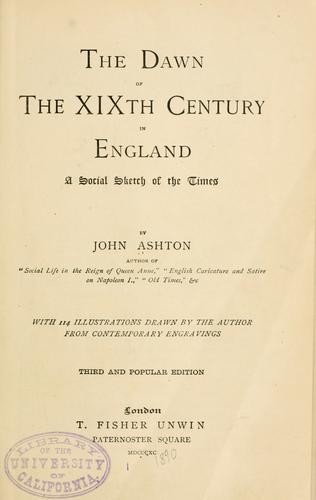
The Dawn of the XIXth Century in England: A social sketch of the timesAshton, John
History
The Dawn of the XIXth Century in England: A social sketch of the times
Ashton, John
England -- Social life and customs -- 19th century
A few years of school, and then, how to get a husband—the same then,
as it is now, and ever will be. Matrimonial advertisements were very
common, and bear the stamp of authenticity; but the following beats
all I have yet seen: “MATRIMONY—To Noblemen, Ladies, or Gentlemen.
Any Nobleman, Lady, or Gentleman, having a female friend who has been
unfortunate, whom they would like to see comfortably settled, and
treated with delicacy and kindness, and that might, notwithstanding
errors, have an opportunity of moving in superior life, by an Union
with a Gentleman holding rank in His Majesty’s service, who has been
long in possession of a regular and handsome establishment, and whose
age, manners, and person, are such (as well as Connections) as, it
is to be presumed, will not be objected to, may, by addressing a
few lines, post paid, to B. Price, Esqre., to be left at the Bar of
the Cambridge Coffee House, Newman Street, form a most desirable
Matrimonial union for their friend. The Advertiser is serious, and
therefore hopes no one will answer this from idle motives, as much
care has been taken to prevent persons from gaining any information,
to gratify idle curiosity. The most inviolable honour and secrecy may
be relied on, and is expected to be observed throughout the treaty.
If the Lady is not naturally vicious, and candour is resorted to, the
Gentleman will study, by every means in his power, to promote domestic
felicity.”
Marriage at _Gretna Green_ was then in full force, and many were the
Couples who went post on that Northern road, and were married by the
blacksmith—as we see in Rowlandson’s picture. These Marriages, which
were, according to the law of Scotland, perfectly legal and binding,
provided the contracting parties avowed themselves to be man and wife
before witnesses, were only made illegal by Act of Parliament in 1856,
and now it is necessary for one of the parties married, to have resided
in Scotland for twenty-one days.
[Illustration: A TRIP TO GRETNA GREEN (ROWLANDSON).]
A curious story about a wedding ring is told in the _Morning Post_ of
the 3rd of December, 1800, under the heading “Clerkenwell Sessions”:
“The Prosecutor, a young man, lately out of his apprenticeship, and in
very confined circumstances, applied, about a month ago, to the Parish
of Shoreditch, and stated, that, it having been his wish to marry a
young woman in the same street where he worked, but not having money
sufficient to buy the wedding ring, and, his intended spouse being as
poor as himself, he hoped their Worships would advance him a small
sum to accomplish the purchase; and then added, that they had already
been three times asked in Church, and the morrow (Sunday) was the day
appointed for the ceremony.
Public-domain text, read in full here on John Shaqi.
Reviews
Reviews
No reviews yet
Be the first to share your thoughts on this work.
Elsewhere in the archive
Join the Discussion
Join the discussion
Sign in to leave a comment or review.
Sign InorCreate an account