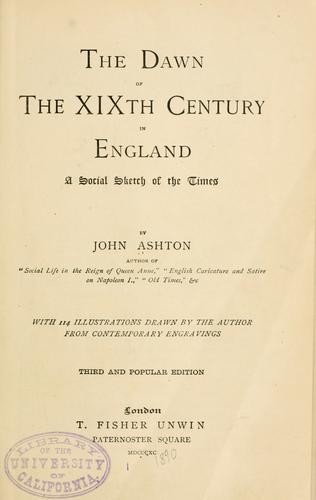
The Dawn of the XIXth Century in England: A social sketch of the timesAshton, John
History
The Dawn of the XIXth Century in England: A social sketch of the times
Ashton, John
England -- Social life and customs -- 19th century
ONE VICE the women of that age had, in common with the men, and that
was Gambling—which, perhaps, was not so bad among the former, as
during the last years of the preceding century, when Ladies Archer,
and Buckinghamshire, and Mrs. Concannon were pilloried, and scourged
metaphorically by the Satirists, as they were promised to be treated,
physically, by Lord Kenyon. Their race was run—as expressed in the
_Morning Post_, January 15, 1800: “Society has reason to rejoice in
the complete downfall of the Faro Dames, who were so long the disgrace
of human nature. Their _die_ is cast, and their _odd tricks_ avail
no longer. The _game_ is up, and very few of them have _cut_ with
_honours_.”
Mrs. Concannon still kept on, but not in London, as is seen by the
following paragraph. _Morning Herald_, December 18, 1802: “The visitors
to Mrs. Concannon’s _petits soupers_, at _Paris_, are not attracted
by _billets_ previously circulated, but by _cards_, afterwards _dealt
out_, in an elegant and scientific manner; not to mince the matter,
they are the rendezvous of _deep play_: and the only questionable point
about the matter is, whether the _Irish_, or the _French_, will prove
victors at the close of so desperate a winter’s campaign.”
Still, we find even in the Royal circle, where the utmost gravity of
demeanour, and purity of manner, were to be found, the card table was
_the_ evening’s amusement. “The evening is, as usual, passed at cards,
in the Queen’s Drawing Room, where three tables are set out.” And cards
were still the staple entertainment both for men and women, at night.
Naturally, the latter did not play for such high stakes as the men
did; but they contrived to make, or lose, a sufficient sum, either to
elate, or to depress them, and experience, as far as in them lay, all
the fierce feelings of the gambler. Nay, some made a pitiful profit out
of their friends—in the shape of “card money”—which meant that the
players put so much, every game, into a pool (generally the snuffer
tray) to pay for the cards, and something for the servants.
It was a practice in its death throes, having been mortally wounded, by
public opinion, at the end of the last century; but the little meanness
still obtained—_vide_ the _Morning Herald_, December 15, 1802: “In a
pleasant village near the Metropolis, noted for its constant ‘tea and
turn out parties,’ the extortion of _Card Money_ had, lately, risen to
such a pitch, that it was no unusual thing for the _Lady_ of the House,
upon the breaking up of a table, to immediately examine the sub-cargo
of the candlestick, and, previous to the departure of her guests,
proclaim aloud the lamentable defalcation of a pitiful shilling, which
they might, perchance, have forgot to _contribute_. We are happy
to find that some of the most respectable people in the place have
resolved to discountenance and abolish this _shabby genteel_ custom,
which has too long prevailed; a shameful degradation of everything like
English hospitality.”
Public-domain text, read in full here on John Shaqi.
Reviews
Reviews
No reviews yet
Be the first to share your thoughts on this work.
Elsewhere in the archive
Join the Discussion
Join the discussion
Sign in to leave a comment or review.
Sign InorCreate an account