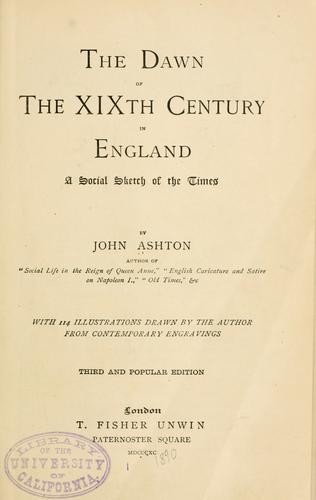
The Dawn of the XIXth Century in England: A social sketch of the timesAshton, John
History
The Dawn of the XIXth Century in England: A social sketch of the times
Ashton, John
England -- Social life and customs -- 19th century
The lower classes in the Metropolis were naturally debarred from
manly sports, by want of room; so that almost their sole muscular
exercise was Skittles. But, in the country, a wholesome rivalry was
engendered among the rustic youth, by means of foot-racing, wrestling,
and Cudgel-playing. The latter still survives in Berkshire, where many
a crown has been cracked at the Scouring of the White Horse (of late
years fallen into desuetude), and many an old “gamester” still lingers,
who can tell long yarns of the hats he has won. At fairs, too, and
holidays, the young lasses used to race for smocks, and many sports
were in vogue that are now never practised, save when resuscitated at
some Harvest Home, or some country school feast.
[Illustration]
[Illustration]
CHAPTER XXXVI.
Hunting then, and now—Hunting near the Metropolis—The Epping
Hunt—Fishing—Shooting then, and now—Guns—Methods of proving gun
barrels—Big charges—Introduction of the Percussion Cap—Size of
bags—Colonel Thornton’s bet.
OF COURSE there was Hunting, both Fox and Stag, but it was not
carried out on the same principles then as now. A man, then, kept a
pack of hounds for his own amusement, that of his friends, and the
neighbourhood generally. A meet, then, was a great social gathering of
neighbours, at which, for the time, all were on a courteous equality,
engendered by similarity of taste, and cemented by means of the Master,
who, at some great expense, kept the pack for others’ use. Now, “the
old order changes, yielding place to new;” the probability is that it
is a subscription pack—with the subscriptions not too well paid, and
the Master frequently changing, owing to his quarrels with his masters,
the subscribers, who carp at his doings, and try to dictate their
own views. The railway brings down the “London Contingent”—sporting
stockbrokers, solicitors, tailors, and publicans—in fact, all who can
scrape together the necessary money to hire the “hunter,” and pay its
fare to the nearest station to the meet. These people have no sympathy
with the farmers, no relations with the county, spend no money,
because they return to London at night, care nought for the damage
they do, which, probably, is done in ignorance; and it is no wonder
that, nowadays, hunting is not so popular among tenant farmers as it
might be—and it is pretty safe to prophesy, that in many districts,
before many more years, it will be reckoned as a thing of the past.
[Illustration: FOX-HUNTING BREAKFAST.]
Then, however, there was never heard a whisper of the scarcity of
foxes. A fox found poisoned, or shot, would have been considered as
an indelible disgrace to the district. The word _vulpecide_ was not
coined, because the crime had not been committed. No farmer ever sent
in a claim to the Hunt, and only old women, cottagers, ever wanted
compensation for the gander, or the two or three hens that they had
lost; as to warning off land, it had never been dreamt of, much less
practised.
Public-domain text, read in full here on John Shaqi.
Reviews
Reviews
No reviews yet
Be the first to share your thoughts on this work.
Elsewhere in the archive
Join the Discussion
Join the discussion
Sign in to leave a comment or review.
Sign InorCreate an account