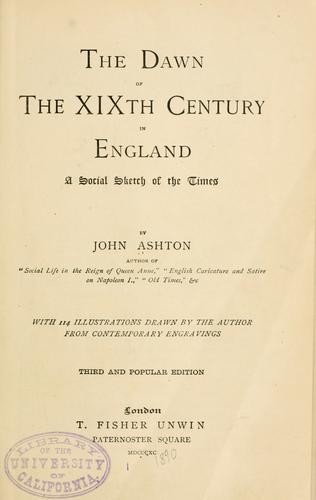
The Dawn of the XIXth Century in England: A social sketch of the timesAshton, John
History
The Dawn of the XIXth Century in England: A social sketch of the times
Ashton, John
England -- Social life and customs -- 19th century
The Guns, with which our grandfathers shot, were vastly inferior to our
modern breechloader; the workmanship was good, but the flint-lock, with
its tardy firing, and the very weak powder then in use, did not render
the “birding gun” a very efficient weapon.
[Illustration: COCK SHOOTING WITH SPANIELS—1804.]
Thornhill, who wrote the _Shooting Directory_ in 1804, is as great an
authority on the subject of guns as any of his contemporaries; and he
had quite sense enough to see that the old-fashioned long barrel of
four feet, or more, carried no further than one of three feet, and he
counselled the musket length of two feet ten inches, as the standard
length for fowling-piece barrels, and preferred one that carried its
shot close, to one that scattered. The method of proving “that a barrel
will not burst, was to get a ball to fit the exact bore, and put the
exact weight of the ball in powder, with which load, and fire it off by
a train; if it does not burst, you need be under no apprehension. This
is called _Tower-proof_; or put in double the quantity of powder and
shot.”
He recommends as a proper charge for a fowling-piece of ordinary
calibre, a drachm and a quarter, or a drachm and a half, of good
powder, and an ounce, or an ounce and a quarter, of shot; and, when
treating on the subject of recoil, he gives one or two anecdotes
of overloading. “The overloading of the piece is the reason of the
recoil; respecting sportsmen who are in the habit of overloading with
shot, such are properly ridiculed in a treatise published some time
since, entitled, ‘Cautions to Young Sportsmen,’ in which we find an
advertisement levelled at some persons who were going to a Pigeon
Shooting Match at _Ballingbear-Warren House_. It was as follows: ‘Take
notice, that no person will be allowed to load with more than four
ounces of shot.’ A gamekeeper to whom this author mentioned the story,
told him he thought it a pretty fair allowance, and, on being told what
charge and weight of shot he generally used, replied, he divided a
pound into five charges.... A friend of the gentleman who relates this
story, seeing his keeper equipped for a pigeon match, had the curiosity
to examine his charge, and, after trying it with his rammer, expressed
his surprise at finding it rather less than usual. ‘Oh, sir,’ replied
the keeper, ‘I have only put in the powder yet;’ and, on putting in
the shot, the charge, altogether, was _eleven_ fingers. The reason he
assigned was ‘that he always liked to give his piece a belly full.’”
Public-domain text, read in full here on John Shaqi.
Reviews
Reviews
No reviews yet
Be the first to share your thoughts on this work.
Elsewhere in the archive
Join the Discussion
Join the discussion
Sign in to leave a comment or review.
Sign InorCreate an account