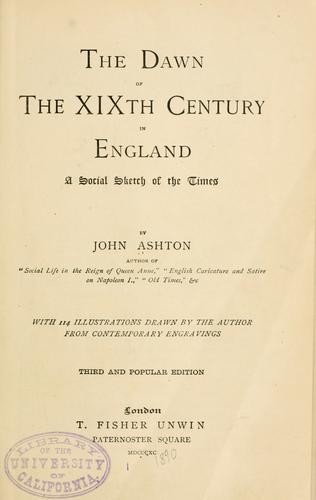
The Dawn of the XIXth Century in England: A social sketch of the timesAshton, John
History
The Dawn of the XIXth Century in England: A social sketch of the times
Ashton, John
England -- Social life and customs -- 19th century
And now I have to chronicle one of the most senseless phases of public
opinion that ever made a page, or a paragraph, of history. The Theatre
opened on September 18, 1809, with “Macbeth” and “The Quaker,” but not
one word that was delivered on the stage could be heard by the audience.
When the curtain drew up, Kemble delivered an address, which was
extremely classical—all about Æschylus, Thespis, and Sophocles,
of which the people present knew nothing, until they saw the next
morning’s papers. Instead of listening, they sang “God save the King”
with all the power of their lungs, and in good order; but that once
over, then, with one consent, they began to yell “NO KEMBLES—no
theatrical tyrants—no domineering Napoleons!—What! will you fight,
will you faint, will you die, for a Shilling?—No imposition!—no
extortion!—English charity.—Charity begins at home.—No
foreigners—No CATALANIS.”
Somebody in the boxes addressed the frantic mob, but nothing was heard
of his speech, and a magistrate named Read, attended by several Bow
Street officers, came on the stage, and produced the Riot Act; it was
no good—he could not be heard, and yet, among the audience, were many
men of position, and even some of the Royal Dukes.
The second night the row was as bad, and it now was becoming organized.
People brought placards, which began mildly with “The Old Prices,”
and afterwards developed into all sorts of curious things. One was
displayed in the first circle of the boxes, and “TOWNSEND,[58] heading
a posse of constables, rushed into the pit to seize this standard of
sedition, together with the standard bearers. A contest ensued of the
hottest kind, staffs and sticks were brandished in all directions; and,
after repeated onsets and retreats, Townsend bore away a few of the
standards, but failed in capturing the standard bearers. He retired
with these imperfect trophies. But, as the oppositionists kept the
field of battle, they claimed the victory, which they announced to
the boxes and galleries with three cheers. The standard bearers in
the boxes were not equally successful. They were but few in number,
and not formed into a compact body, and had, besides, their rear and
flanks open to the attack of the enemy. Some of them we saw seized from
behind, and dragged most rudely out of the boxes, and treated, in every
respect, with a rigour certainly _beyond_ the _law_. One of them, who
had all the appearance of a gentleman, was accompanied by a lady, who
screamed at seeing the rudeness he suffered, and then flew out of the
box to follow him. This vigorous activity on the part of the constables
made the placards disappear for a time; but they were soon after
hoisted again in the pit, and hailed with acclamations every time they
were observed.”
Public-domain text, read in full here on John Shaqi.
Reviews
Reviews
No reviews yet
Be the first to share your thoughts on this work.
Elsewhere in the archive
Join the Discussion
Join the discussion
Sign in to leave a comment or review.
Sign InorCreate an account