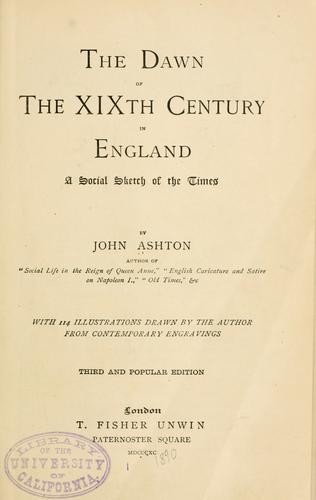
The Dawn of the XIXth Century in England: A social sketch of the timesAshton, John
History
The Dawn of the XIXth Century in England: A social sketch of the times
Ashton, John
England -- Social life and customs -- 19th century
The “Invisible Girl” was exhibited in Leicester Square, and was “a
globe of glass suspended by a ribbon, under which four tubes are
adapted, but they do not communicate therewith, and are likewise
insulated; by these, conversation is carried on with an invisible lady,
who answers every question, breathes on you, and tells every visitor
whatever they hold in their hands, in an instant. This exhibition is
open from ten o’clock until six. Price of admittance, _two shillings
and sixpence_.”
There were two famous out-door places of amusement, now no more,
namely, Vauxhall, and Ranelagh. Vauxhall, was formerly called Foxhall,
or Spring Garden, and is thus described in No. 383 of the _Spectator_:
“We were now arrived at Spring Garden, which is excellently pleasant
at this time of the year. When I considered the fragrancy of the walks
and bowers, with the choir of birds that sung upon the trees, and the
loose tribe of people that walked under their shades, I could not but
look upon the place as a kind of Mahometan paradise. Sir Roger told me
it put him in mind of a little coppice by his house in the country,
which his chaplain used to call an aviary of nightingales. ‘You must
understand,’ says the knight, ‘that there is nothing in the world that
pleases a man in love, so much as your nightingale. Ah, Mr. Spectator,
the many moonlight nights that I have walked by myself, and thought
on the widow by the music of the nightingale!’ He, here, fetched a
deep sigh, and was falling into a fit of musing, when a mask, who came
behind him, gave him a gentle tap upon the shoulder, and asked him if
he would drink a bottle of mead with her? But the knight being startled
at so unexpected a familiarity, and displeased to be interrupted in
his thoughts of the widow, told her, ‘she was a wanton baggage;’ and
bid her go about her business.”
[Illustration: VAUXHALL GARDENS—1808-9.]
These gardens opened about the middle of May, and closed about the end
of August; they were only open three days a week—Monday, Wednesday,
and Friday; and the price of admission was 3s. 6d., the concert
commencing at eight, the attendance averaging from 5,000 to 15,000.
At the end of the first part of the concert, about 10 p.m., a curtain
was drawn up, and disclosed “a view of a bridge, a water mill, and
a cascade; while coaches, waggons, soldiers, and other figures were
exhibited as crossing that bridge.” The orchestra, which I reproduce,
was a blaze of light, and, altogether, in the gardens, at that time,
were 37,000 lamps. Occasionally, a display of fireworks took place;
whilst, to add to the attractions of the gardens, there were recesses,
and alcoves, provided, where suppers, and refreshment, could be
procured.
Public-domain text, read in full here on John Shaqi.
Reviews
Reviews
No reviews yet
Be the first to share your thoughts on this work.
Elsewhere in the archive
Join the Discussion
Join the discussion
Sign in to leave a comment or review.
Sign InorCreate an account