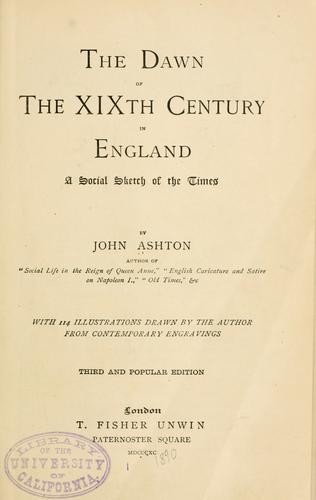
The Dawn of the XIXth Century in England: A social sketch of the timesAshton, John
History
The Dawn of the XIXth Century in England: A social sketch of the times
Ashton, John
England -- Social life and customs -- 19th century
Engravers, too, furnish a list of well-known names, among whom, for
delicacy of work, Francis Bartolozzi probably stands pre-eminent, his
engravings challenging competition at the present day. There were also
Thomas Holloway, and William Sharp; but, perhaps, the most popular
names—none of whom will ever rank as first-class engravers—are
Gillray, Rowlandson, and Isaac and George Cruikshank. Their names were
on every lip, and their works the theme of every tongue. Nor must we
forget John Boydell, who was Alderman and Lord Mayor of the City of
London. Not only an engraver by profession, he encouraged art, by
commissioning the first artists of the day to paint pictures, which
he afterwards had engraved, notably his magnificent Shakespeare, than
which there is no more sumptuous English edition. On this he spent no
less than £350,000, and by this expenditure of capital, and bad trade,
owing to the war with France, and the stoppage of commercial relations
with the Continent, he fell into debt, and was obliged to get an Act of
Parliament passed to enable him to get rid of the original pictures and
plates, of his Shakespeare Gallery, by a lottery, which was drawn in
1804.
Besides the Shakespeare Gallery in Pall Mall, and Alderman Boydell’s
Gallery in Cheapside, there were several dealers’ collections—the
chief of which was “The European Museum,” Charles Street, St. James’s
Square. Here pictures, some of them good, were on sale on commission,
and, to prevent its being merely a lounge, a shilling was charged for
admission.
Not to be forgotten are the two Water Colour Societies—“The Exhibition
of Paintings in Water Colours,” established in 1804, and located in
1808 in Bond Street. Reinagle was treasurer, and its members were
Messrs. G. Barrett, J. J. Chalon, J. Christall, W. S. Gilpin, W.
Havell, T. Heaphy, J. Holworthy, F. Nicholson, N. Pocock, W. H. Pyne,
S. Rigaud, S. Shelley, J. Smith, J. Varley, C. Varley, and W. F. Wells.
The associate members were Miss Byrne, and Messrs. J. A. Atkinson, W.
Delamotte, P. S. Munn, A. Pugin, F. Stevens, and W. Turner.
The other society was started in 1808 or 1809, under the title of
“The Associated Artists in Water Colours,” and their first exhibition
was held at 20, Lower Brook Street, Grosvenor Square, where a picture
gallery already existed.
It is a thankless task to attempt to give a list of names of literary
note, of this epoch, because, as in the case of foregoing lists, it is
impossible to avoid giving some critic occasion to slay—an omitted
name, being a heinous sin, outweighing all the patient hard work of
research and reading, necessary for the writing of a book like this.
Still an attempt thereat is bound to be made:
Public-domain text, read in full here on John Shaqi.
Reviews
Reviews
No reviews yet
Be the first to share your thoughts on this work.
Elsewhere in the archive
Join the Discussion
Join the discussion
Sign in to leave a comment or review.
Sign InorCreate an account