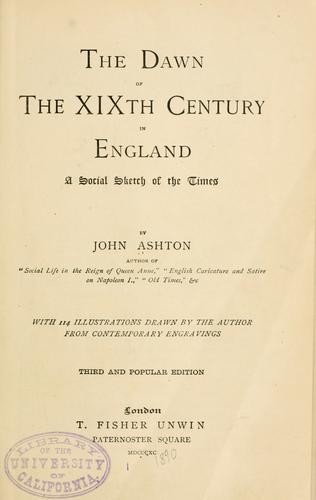
The Dawn of the XIXth Century in England: A social sketch of the timesAshton, John
History
The Dawn of the XIXth Century in England: A social sketch of the times
Ashton, John
England -- Social life and customs -- 19th century
The truth is, that, at the end of the eighteenth century, Galvani and
Volta, Sir Joseph Banks, in connection with the Royal Society, and
all the scientific men of the day, were deeply interested in solving
the mysteries of electricity; and, as nobody, as yet, knew much about
it, the public were liable to be gulled by any empiric, and Benjamin
Douglas Perkins was the very man to do it. He, and others, wrote
several pamphlets on “The Influence of Metallic Tractors on the Human
Body, in removing various Inflammatory Diseases,” and such like, and
opened a _Perkinean Institution_ in London. He must have been fairly
successful, for his advertisements lasted some years. His published
cures were miraculous: “A Lady was afflicted with an Erysipelas in her
face.... In a few minutes she cheerfully acknowledged that she was
quite well.” “A man aged 37 had, for several years, been subject to the
Gout. I found him in bed, and very much distressed with the disease
in one of his feet. After I had operated upon it with the Tractors he
said the pain was entirely gone.” “A Lady burned her hand. I, happily,
called at the house immediately after the accident, and applied the
Tractors. In about ten minutes, the inflammation disappeared, the
vesication was prevented, and she said the pain was gone.” The price
of these “blessings to men” was five guineas a set; and he explains
them in the specification of the patent granted him on the 10th March,
1798, where, speaking of Galvanism, he says, “Among the metals that may
be thus characterised, I have found none more eminently efficacious in
removing diseases than the combinations of copper, zinc, and a small
proportion of gold: a precise quantity of each is not necessary: also
iron united to a very small proportion of silver and platina; an exact
proportion of these also not necessary. These are constructed with
points, and of such dimensions as convenience shall dictate. They may
be formed with one point, or pointed at each end, or with two or more
points. The point of the instrument thus formed I apply to those parts
of the body which are affected with diseases, and draw them off on
the skin, to a distance from the complaint, and usually towards the
extremities.”
Public-domain text, read in full here on John Shaqi.
Reviews
Reviews
No reviews yet
Be the first to share your thoughts on this work.
Elsewhere in the archive
Join the Discussion
Join the discussion
Sign in to leave a comment or review.
Sign InorCreate an account