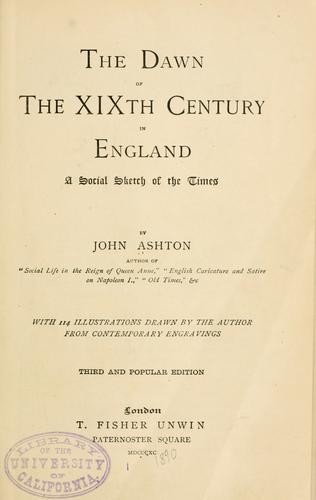
The Dawn of the XIXth Century in England: A social sketch of the timesAshton, John
History
The Dawn of the XIXth Century in England: A social sketch of the times
Ashton, John
England -- Social life and customs -- 19th century
“All effective Members of Volunteer Corps and Companies accepted by
His Majesty, are entitled to the exemptions from ballot allowed by 42
Geo. III. cap. 66, and Geo. III. cap. 121, provided that such persons
are regularly returned in the muster rolls to be sent in to the Lord
Lieutenant, or Clerk of the General Meetings of his County, _at the
times_, _in the manner_, and certified upon honour by the Commandant,
_in the form_ prescribed by those Acts, and schedules thereto annexed.
“The Monthly Returns should be transmitted to the Inspecting Field
Officer appointed to superintend the District in which the Corps is
situated, and to the Secretary of State for the Home Department.”
* * * * *
Thus, we see that the regulations for the Volunteers were very similar
to what they are now.
Of course the arms served out to them were, to our modern ideas,
beneath contempt. There were a few Rifle Corps, who were armed with
what was then called the Brunswick Rifle. It was short, because the
barrel was very thick and heavy. The rifling was poly-grooved, the
bullet spherical, and somewhat larger than the bore, so that when
wrapped in a greased linen patch (carried in a box, or trap, in the
butt of the gun) it required a mallet applied to the ramrod—to drive
the bullet home—and fill up the grooves of the rifling. Of course it
was a far superior weapon to the musket, or “Brown Bess”[75]—which
was not calculated even to “hit a haystack” at thirty yards. The
_Morning Post_, July 24, 1810, thus speaks of the shooting of a Corps:
“The Hampstead Volunteers fired at a target yesterday on the Heath.
Many excellent shots were fired, and some nearly entered ‘the Bull’s
eye.’”
They were always holding Volunteer reviews, and having Volunteer
dinners, and Volunteers, generally, were raised to the rank, at least,
of demigods—they were the saviours of their country. Never was there
such bravery as that of these fire-eaters: and, if _Boney_ dared
show his nose on English soil—why—every British Volunteer would,
individually, capture him! Volunteering even made them moral, and
religious—_teste_ the _Times_, September 3, 1803: “Since the formation
of Volunteer Corps, the very manners of many have taken a more moral
turn: public-houses are deserted for the drill, our churches are better
frequented, profane swearing is banished, every man looks to his
character, respects the Corps in which he is enrolled, and is cautious
in all he says or does, lest he should disgrace the name of a _British
Volunteer_.”
Public-domain text, read in full here on John Shaqi.
Reviews
Reviews
No reviews yet
Be the first to share your thoughts on this work.
Elsewhere in the archive
Join the Discussion
Join the discussion
Sign in to leave a comment or review.
Sign InorCreate an account