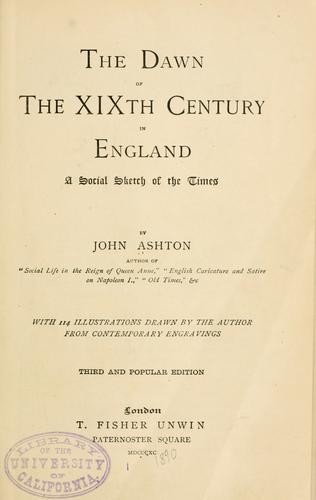
The Dawn of the XIXth Century in England: A social sketch of the timesAshton, John
History
The Dawn of the XIXth Century in England: A social sketch of the times
Ashton, John
England -- Social life and customs -- 19th century
[11] W. Toone, “The Chronological Historian.”—[When the Julian
Calendar was introduced, the Vernal Equinox fell on the 25th of March.
At the time of the Council of Nice, A.D. 325, it had retrograded to
the 21st of March; and when the reformation was made in 1582, to
the 11th of March. Pope Gregory XIII., to restore it to its place,
directed ten days to be suppressed in the calendar; and as the use of
the Julian intercalation was found to be three days in 400 years, he
ordered the intercalation to be omitted in all the centenary years
except those which were multiples of 400. According to Gregorian rule,
therefore, every year of which the number is divisible by four, without
a remainder, is a leap year, excepting the centenary years, which are
only leap years when divisible by four, on suppressing the units and
tens. Thus—
16(00) is a leap year. 17(00), 18(00), 19(00), are not leap years.
20(00) is a leap year.
The shifting of days caused great disturbance in festivals dependent
on Easter. Pope Gregory, in 1582, ordered the 5th of October to be
called 15th of October; the Low Countries made 15th of December 25th of
December. Spain, Portugal, and part of Italy, accepted the Gregorian
change, but the Protestant countries and communities resisted up to
1700. In England the ten days’ difference had increased to eleven
days, and the Act of 24 Geo. II. was passed to equalize the style in
Great Britain and Ireland to the method now in use in all Christian
countries, except Russia. In England, Wednesday, September 2, 1752, was
followed by Thursday the 14th of September, and the New Style date of
Easter-day came into use in 1753.—_Note by John Westby Gibson, Esq.,
LL.D._]
[12] The Great Seal in use in 1800, was the fifth made during the reign
of George III. Its Obverse was the King, in Roman costume, with flying
mantle, on horseback, facing left hand. In his right hand he holds a
marshal’s baton. Legend—both Obv. and Rev. “Georgius III. D.G. BRIT.
FR. REX. F.D. BRVNS. ET. LVN. DVX. S.R.I.A.T. ET. PR. ELECT. ETC.” The
Reverse has the King royally robed and crowned, seated on a throne, on
the back of which is emblazoned the Royal arms. He holds the sceptre in
his right, the orb in his left hand. He is surrounded by allegorical
figures. On his right (heraldically) stand Hercules, typical of Power,
Minerva, of Wisdom, and Justice with sword and scales; on his left
are Britannia with spear, shield, and palm branch, and a female,
figurative of piety, carrying the model of a church. The Seal of 1801
is identical, except that BRITANNIANUM is substituted for BRIT., and
FR. is left out. Also in the Royal arms on the throne, the French
_fleur de lys_ is omitted, and the harp of Ireland is introduced. It is
worthy of note, that the medallist has omitted the Cross of St. Patrick
in Britannia’s shield, although proclaimed.
Public-domain text, read in full here on John Shaqi.
Reviews
Reviews
No reviews yet
Be the first to share your thoughts on this work.
Elsewhere in the archive
Join the Discussion
Join the discussion
Sign in to leave a comment or review.
Sign InorCreate an account