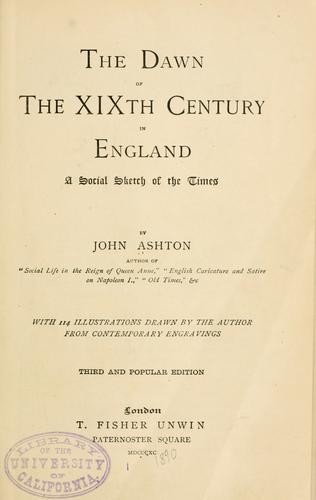
The Dawn of the XIXth Century in England: A social sketch of the timesAshton, John
History
The Dawn of the XIXth Century in England: A social sketch of the times
Ashton, John
England -- Social life and customs -- 19th century
SIR,—Can it be true—as rumour has it—that in an old-established
gambling club, not 100 miles from St. James’s Street, enormous sums are
nightly staked, and that fortunes rapidly change hands? I hear that
three men sat down a few nights ago to play écarté in this said club,
and that one of their number was at a certain period of the evening a
loser of the enormous sum of £100,000. That when this very impossible
figure was reduced to limits within which the winners considered the
loser could pay, play ceased and the party broke up. The next day—so
runs the story—one of the winners called with bills to the amount
of £26,000, drawn on stamped paper, for the loser to accept. This
gentleman, however, though he freely admits having played, states that,
having dined not wisely but too well, he has no sort of recollection of
losing any specific sum, but merely a hazy idea that fabulously large
amounts were recklessly staked all round, and no accounts kept. In
other words, he repudiates, and finally, after a lengthened discussion,
has consented to place himself in the hands of a friend to decide what
he is to pay. If this is true, and I have no reason to doubt it, I can
only stigmatize the whole affair as a public scandal, and the police
should promptly interfere and shut up a club where such disgraceful
things occur. When Jenks’s baccarat ‘hell’ was closed, and Mr. J.
Campbell Wilkinson and his six associates were each fined £500 (hence
the very excellent _bon mot_ which appeared in the _Sporting Times_
that ‘Jenks’ babies’ had become ‘Jenks’ monkeys’), the public were
justified in believing that, at last, there was not to be one law for
the rich and another for the poor, and that in future men who broke the
law by gambling for thousands, would have the same justice meted out to
them as those who did so by tossing for coppers. However, it appears
such hopes were premature, and before this happy state of things is
arrived at, further attention must be drawn to the matter, hence this
letter, for which I sincerely trust you will be able to find space.—I
am, Sir, yours, &c.,
“A HATER OF PROFESSIONAL GAMBLERS.
“January 24th.”
[52] In May, 1775, a Bluecoat boy confessed that he had been tampered
with, and had concealed a ticket, which was afterwards drawn. A man
was arrested as the accomplice, but was discharged; but the Lottery
Committee, in order to prevent a similar fraud, moved the following
resolution (December 12, 1775), which was afterwards always adhered to:
“That it be requested of the _Treasurer of Christ’s Hospital_, not to
make known who are the twelve boys nominated for drawing the lottery
till the morning the drawing begins; which said boys are all to attend
every day, and the two who are to go on duty at the wheels, are to be
taken promiscuously from amongst the whole number, by either of the
Secretaries, without observing any regular course, or order; so that no
boy shall know when it will be his turn to go to either wheel.”
Public-domain text, read in full here on John Shaqi.
Reviews
Reviews
No reviews yet
Be the first to share your thoughts on this work.
Elsewhere in the archive
Join the Discussion
Join the discussion
Sign in to leave a comment or review.
Sign InorCreate an account