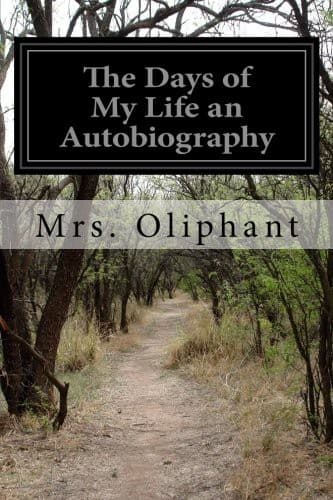
The Days of My Life: An AutobiographyOliphant, Mrs. (Margaret)
General
The Days of My Life: An Autobiography
Oliphant, Mrs. (Margaret)
Oliphant, Mrs. (Margaret), 1828-1897
I had nothing to say to this. Nor could I have expected that she would
understand _me_. We were walking quickly, for it required no small
exertion to keep up with Miss Saville, who strode along in her thick
boots with a manly disregard of every obstacle--along the lane which led
to the village. Just before we reached Cottisbourne, we passed the
Rectory. Miss Saville looked up at it as she passed, and so did I. I was
startled to see a face looking out from the window, which I recognised,
or fancied I recognised. It was a weather-beaten face, unshaven and
slovenly, and stooped forward with an inquisitive, sidelong glance. I
tried to recollect where I had seen it. Could this be Saville--_the_
Saville--the man who brought Edgar Southcote to Cottiswoode? I was
disposed to think so. My companion gazed at him a moment, and then waved
her hand impatiently, as if to bid the man go from the window. Yet I had
been now three weeks at Cottiswoode, had frequently seen the clergyman
and his sister, but had never heard of another. I wondered why they
concealed him--I wondered if it _was_ he; but Miss Saville never spoke.
We were close upon the village now. The first group of two or three
houses stood by themselves upon the brown grass of the meadow-land
around. They seemed to have no gardens, no trees, nothing to protect or
shelter them; but stood apart among the grass, which pressed round their
very walls and doorsteps, as if it grudged the little bit of ground they
occupied. There were some plants in the window of almost every house,
poor, shabby plants, crushed against the green gauze curtain suspended
across the three lower panes, darkening the light; but doing little
else by way of compensation. The want of gardens seemed to disconnect
them strangely from the soil on which they stood. There was no beauty or
sentiment about them; but only very poor, meagre, hungry poverty. Beyond
them, a very small stream, which made no sound in the heavy, deadened
atmosphere, wound through a field, with some low willows standing by,
like a class of unkempt boys at school. A little further on, withdrawn
into a grassy mass, was the village well, with its bucket and windlass;
and then came Cottisbourne proper, a cluster of houses oddly placed,
with strange little narrow lanes winding among them, as intricate as a
child's puzzle: some brown and dingy, with the thatched roof clinging
upon them like a growth of nature--some brilliantly whitewashed, with
great patches of damp, from the rain, upon their walls. One or two carts
tilted up, stood in a corner of the bit of common which belonged to the
village. About them, and in them, were a number of children, whose
voices scarcely woke the sullen air to cheerfulness. The houses stood
about in genuine independence, every one faring as it pleased him, and
the wealthy cottager's pig sniffed the same air as his master, and
placidly meditated upon the doings of his master's next neighbor, whose
Public-domain text, read in full here on John Shaqi.
Reviews
Reviews
No reviews yet
Be the first to share your thoughts on this work.
Elsewhere in the archive
Join the Discussion
Join the discussion
Sign in to leave a comment or review.
Sign InorCreate an account