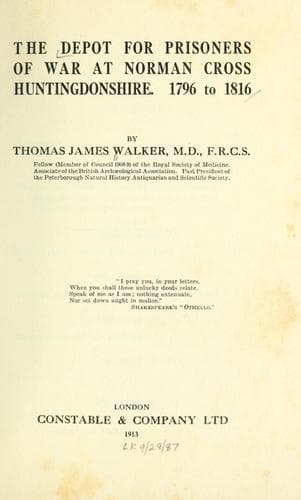
The Depot for Prisoners of War at Norman Cross, Huntingdonshire. 1796 to 1816Walker, Thomas (Thomas James)
History
The Depot for Prisoners of War at Norman Cross, Huntingdonshire. 1796 to 1816
Walker, Thomas (Thomas James)
France -- History -- 1789-1815; Norman Cross depot; Prisoners of war
The autobiography is practically that of an émigré, although the
Bishop-designate was a “déporté.” Most of these aristocrats,
ecclesiastics, and others who fled from France at a time when, had they
possessed the courage to remain, they might have much altered the course
of events, took refuge in Austria, Italy, and other continental Catholic
countries. Comparatively few came to England. From the Bishop we learn
that in 1791, having been designated Bishop of Moulins, he was expelled
from France. He took refuge in Italy, where he had the good fortune to
become Chief Chaplain to the Bourbon Princess, Victoire of France, “to
whose bounty he owed his existence,” and at her death, in 1799, he was
left absolutely without any resources. Under these circumstances he came
to England, where he received the allowance granted to bishops at that
time, £10 a month. In his narrative the Bishop enters into further
details as to his misfortunes. He found his relatives in London in
distress; he advanced them moneys which he obtained from money-lenders,
who made the loans on the security of his expectations—expectations which
came to nothing. When the Bishop’s father died, leaving a goodly
inheritance, the whole was appropriated by his relatives, who took
advantage of the Bishop’s absence from France. His brother suggested to
him that if he would return to France and submit to the Government, they
might help him. This the Bishop would never do, his devotion and loyalty
to the Bourbons made it impossible, and in 1808 he is found at Stilton
writing a begging letter from the Bell Inn—not there “out of pure
compassion for his imprisoned countrymen,” but a “déporté” from France,
who, when he arrived in England, was without any resources beyond his
great expectations, on the strength of which the Bishop was able to
obtain money from usurers, to one of whom this unfortunate prelate was
paying 30 per cent. per annum for a loan of £200. He was not “living on
his own charges and upon remittances from France,” but upon £240 a year
paid to him by the British Government.
To this payment by the British Government was added the extraordinary
privilege of the liberation of a lad from Norman Cross to act as his
servant. This was a further favour from the Government which was feeding
him and clothing him. The Bishop’s return for these acts of grace was to
allow the lad to join in the illegal straw-plait traffic, and then to
make the application which, reading between the lines of Sir Rupert
George’s letter, it was easy to see was regarded by the Transport Board
as a gross piece of effrontery. The sequel was more letters in the
effusive begging-letter style of a century ago to the tender-hearted,
influential nobleman whose acquaintance he had made, and the ultimate
granting of another servant.
Public-domain text, read in full here on John Shaqi.
Reviews
Reviews
No reviews yet
Be the first to share your thoughts on this work.
Elsewhere in the archive
Join the Discussion
Join the discussion
Sign in to leave a comment or review.
Sign InorCreate an account