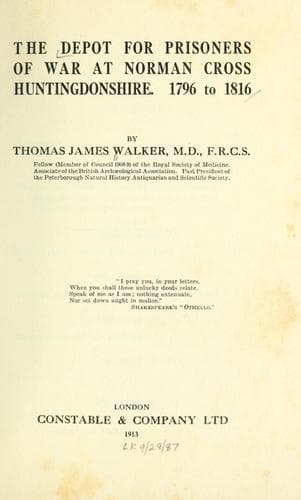
The Depot for Prisoners of War at Norman Cross, Huntingdonshire. 1796 to 1816Walker, Thomas (Thomas James)
History
The Depot for Prisoners of War at Norman Cross, Huntingdonshire. 1796 to 1816
Walker, Thomas (Thomas James)
France -- History -- 1789-1815; Norman Cross depot; Prisoners of war
From other sources we gather that the Rt. Rev. Etienne Jean Baptist,
Louis de Galois de la Tour, who was fifty-four years of age at the date
of the correspondence, {187} was an ecclesiastic of great distinction.
He was the son of Charles Jean Baptist de Galois de la Tour, who was
French Administrator in 1788 at Moulins and first President of the
Department of Aix, where the future Archbishop was born in 1754. He
became Vicar-general of the See of Autun and doyen of the College of St.
Pierre at Moulins. He had been designated to the See of Moulins, when in
1791 the order for his arrest was issued, and he was “déporté” according
to the official list of émigrés published in Paris in 1793. In the
Bishop’s own narrative he says, “L’Évêque de Moulins, parti de France en
1791.” Of his life and fortunes from that year until 1808 we have his
own account. In 1814, after twenty-three years of exile, he returned
with the Bourbons to France, but he was not at once consecrated or even
appointed to the See of Moulins.
His attitude towards the Pope and the French Government during his
banishment can be seen in three rare pamphlets published in London in
1802 and 1803. {188a} The Pope (Pius VII.) was remonstrated with for
coming to terms with the French Government. To the first remonstrance,
dated 23rd December 1801, one archbishop and twelve bishops affix their
signatures, to which a cross is prefixed; Etienne de la Tour signs last,
as nominated Bishop of Moulins, without the cross. In April 1803 he
signs at the end of three archbishops and thirty-five bishops, this time
with a cross. {188b} The history of the quarrel between the parties and
final reconciliation can be seen in Thiers: _History of the French
Revolution_ (Shobul’s Trans.), 1895, vol. i., pp. 105–6, 145, 187.
After some correspondence and an acknowledgment of his error the
Bishop-designate was consecrated, and two years later he was elevated to
the archbishopric of Bourges.
The Archbishop did not live more than four years to occupy the lofty
position which he had won by his personal attributes, by his fidelity to
the House of Bourbon, by his services to the Church, by his twenty-three
years’ banishment from France involuntary and voluntary, by his
experiences at Norman Cross, {188c} among which the little incident of
his association, through Jean Baptiste David, with the straw-plait
smuggling business might, by the Roman Catholic hierarchy and even by the
Bourbon Government, not be reckoned as otherwise than meritorious.
The Archbishop, who had for so many years lived at Stilton on a pittance
allowed by the British Government, and had served his fellow countrymen
within the walls of the Norman Cross Prison, died in his palace at
Bourges on 20th March 1820.
Public-domain text, read in full here on John Shaqi.
Reviews
Reviews
No reviews yet
Be the first to share your thoughts on this work.
Elsewhere in the archive
Join the Discussion
Join the discussion
Sign in to leave a comment or review.
Sign InorCreate an account