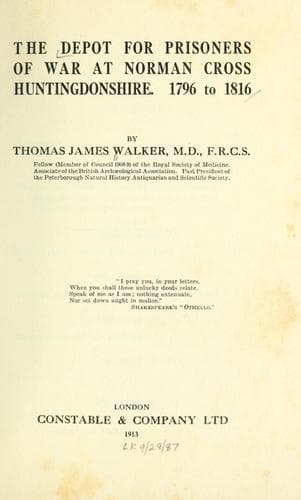
The Depot for Prisoners of War at Norman Cross, Huntingdonshire. 1796 to 1816Walker, Thomas (Thomas James)
History
The Depot for Prisoners of War at Norman Cross, Huntingdonshire. 1796 to 1816
Walker, Thomas (Thomas James)
France -- History -- 1789-1815; Norman Cross depot; Prisoners of war
A note in the register of the soldiers received at Norman Cross states
that with certain chasseurs français who arrived at the prison on 9th
September 1809, arrived two women and a child. How they were disposed of
between that date and 24th December of the same year, when they were
discharged to France, is not recorded. One of the women got only as far
as Lynn on her way home, and in the following March returned to Norman
Cross; her further adventures are not recorded.
The numbers of those on parole varied greatly in the course of the war.
In the year 1796, in which the building of Norman Cross was commenced,
the number was 1,200; on 30th April 1810, out of a total of 44,583
prisoners, 2,710; and on 11th June 1811, out of 49,132 prisoners, 3,193.
The number on parole would greatly increase as more prisoners passed into
the country. The Duke of Wellington, in one of his despatches dated 23rd
December 1812, summarising the result of the campaign in Spain, mentions
that “In the months which have elapsed since January, this army has sent
to England little short of 20,000 prisoners.” Of these many came to
Norman Cross. The number continued to increase until the total in
Britain reached 67,000, that being the number returned to France after
the Treaty of Paris was signed on 30th May 1814.
The prisoners on parole were widely distributed in various towns, many of
them distant from any large depot. {192} Agents were appointed in each
place to look after and pay the prisoners who lodged either in the town
itself or in the neighbouring villages. Of the 1,200 on parole in 1797,
100 were in Peterborough and its neighbourhood, and the agent who
accepted the responsibility of looking after them, paying them and
mustering them at stated intervals when they had to report themselves to
him, was Mr. Thomas Squire, a merchant and banker living in the Bridge
House, in whose field, on the river bank, the second batch of prisoners
consigned to Norman Cross in April 1797 landed from the barges which had
brought them from Lynn. The only parole register relating to
Peterborough which the author could find in the Record Office is a volume
dating from 1795 to 1800, and refers mainly to the Dutch. In this volume
there are entered, between 10th November 1797 and 3rd July 1800, the
names of 100 Dutch prisoners on parole at Peterborough. The first French
were the captain, four lieutenants, the purser, surgeon, and first pilot
of _La Jalouse_, in June 1797.
No corresponding record has been found as to the disposal of those who
arrived at Norman Cross in the second period of the war, 1803–15, and who
by their rank or social status were entitled to parole. It is probable
that on the officer who received them at the port where they landed,
devolved the duty of selecting the parole prisoners and sending them
direct to the towns where they were to be interned when the general body
of prisoners went to Norman Cross.
Public-domain text, read in full here on John Shaqi.
Reviews
Reviews
No reviews yet
Be the first to share your thoughts on this work.
Elsewhere in the archive
Join the Discussion
Join the discussion
Sign in to leave a comment or review.
Sign InorCreate an account