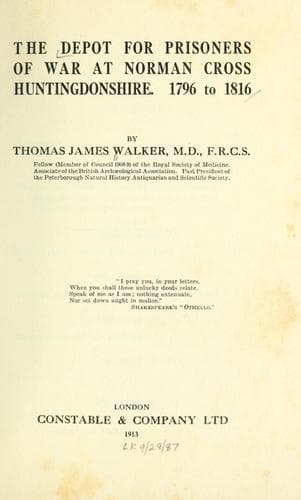
The Depot for Prisoners of War at Norman Cross, Huntingdonshire. 1796 to 1816Walker, Thomas (Thomas James)
History
The Depot for Prisoners of War at Norman Cross, Huntingdonshire. 1796 to 1816
Walker, Thomas (Thomas James)
France -- History -- 1789-1815; Norman Cross depot; Prisoners of war
Although the bitter antagonism which existed between the French and the
British during this long war would militate against it, there is no doubt
that occasionally the prisoners on parole visited and formed friendships,
and even attachments, among their neighbours according to their degree.
This general statement made to the writer by his parents and other
nonagenarians is borne out by the marriages to be mentioned directly, but
although the writer has lived in Peterborough, excepting the few years
when his education took him away, for three-quarters of a century, he
does not recollect ever to have heard of any special instance of the
survival of such a friendship in the city or in the immediate
neighbourhood of Norman Cross, excepting those to be detailed when the
marriages of the prisoners are dealt with.
It has been thought not irrelevant to the history of Norman Cross to
devote the succeeding chapter to the subject of the English Prisoners in
France, and it will be there seen that in the letter written by Lieut.
Tucker from Verdun, he specially says, “there is no society between the
English and the French.”
When in 1814 Napoleon abdicated, and the Treaty of Paris was signed on
the 30th May, some 70,000 French prisoners, of whom nearly 4,000 were out
on parole, together with hundreds of émigrés, left our shores. These
friendships and close associations were abruptly cut short, and the
foreign element in British Society appears to have been speedily
forgotten. The intimacies which were kept up, of which we read in the
biographies and family archives of those who lived in the first half of
the last century, were almost all between the British and the French
émigré, not between the British and the prisoners on parole; they were
between persons who, although of different nationalities, agreed in their
political sympathies, and who were equally opposed to the existing French
Government.
Between 1793 and 1814 about 200,000 Frenchmen and other foreigners (at
various periods, not all at one time), either in durance or on parole,
spent a longer or shorter period of their lives in Great Britain. In the
second period of the war (1803–15) there were 122,440, and of these
probably 4,000 at least were out on parole, including in this estimate
not only the commissioned officers, but also the large number of officers
of privateers and of civilians of various occupations who were all
reckoned as prisoners of war. {202}
Public-domain text, read in full here on John Shaqi.
Reviews
Reviews
No reviews yet
Be the first to share your thoughts on this work.
Elsewhere in the archive
Join the Discussion
Join the discussion
Sign in to leave a comment or review.
Sign InorCreate an account