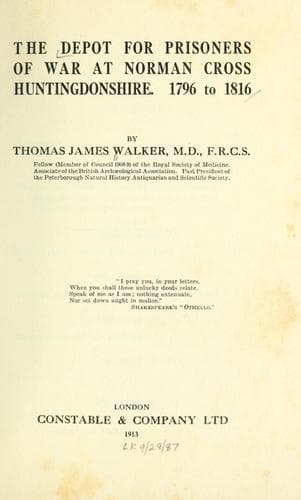
The Depot for Prisoners of War at Norman Cross, Huntingdonshire. 1796 to 1816Walker, Thomas (Thomas James)
History
The Depot for Prisoners of War at Norman Cross, Huntingdonshire. 1796 to 1816
Walker, Thomas (Thomas James)
France -- History -- 1789-1815; Norman Cross depot; Prisoners of war
Very little more evidence is found in the minutes of the English Lodges.
At _Ashburton_ is the record of the Initiation of a Frenchman. At
_Selkirk_ twenty-three parole prisoners who were masons were enrolled as
members of the Lodge, and they were allowed the use of the Lodge Room for
their own business and ceremonies.
At _Northampton_, in the neighbouring county to that in which Norman
Cross is situated, a French Lodge (“La Bonne Union”) was established, but
there is no tradition of any association with the English Brethren.
At _Ashby-de-la-Zouch_ a French Lodge was formed, but there is no record
of any intercourse with the English Brethren. Ashby was a large depot
for parole prisoners, some 200 being located in the town and
neighbourhood, and there is a tradition that the French Lodge of
Freemasons gave a ball to which they invited many of the inhabitants.
One reason why the Brethren of the French and English nations apparently
associated to such a small extent, is that the British masons would, as a
rule, regard the French Lodges as irregular and self-constituted, they
having no mandate from the Grandmaster of England or Scotland.
In Peterborough there is no record or tradition of a French Lodge.
Mr. Thorp, in the little history from which these facts are drawn,
mentions the marriage of a member of the French Lodge at
Ashby-de-la-Zouch, Brother Louis Jan to a Miss Edwards, in 1809. The
couple went to France in 1814, returned to England for some years, but
went back to Rouen, where M. Jan died. His widow came back to Ashby,
where she supported herself and her children by teaching French. She
died in 1867.
As regards the parole prisoners whose headquarters were at Peterborough,
a careful search through the marriage register of St. John’s Church has
failed to discover an entry of any marriage which can be identified as
that of a French prisoner and English girl; but in the years 1800–01 five
marriages between Dutch prisoners and English girls were celebrated in
the church and duly registered.
The first three bridegrooms were young officers, who were married on the
eve of their restoration to liberty under the terms of the Convention of
Alkmaar. From the register of Dutch Prisoners of War in the Record
Office, we have been able to identify these bridegrooms. In the Parish
Church Register there is absolutely no hint that the bridegrooms were
prisoners of war. The names only are given, without any description,
although the statement that there are entries of French prisoners,
designated as such, in this marriage register having been once made, has
been adopted time after time by writers and lecturers on this subject.
Public-domain text, read in full here on John Shaqi.
Reviews
Reviews
No reviews yet
Be the first to share your thoughts on this work.
Elsewhere in the archive
Join the Discussion
Join the discussion
Sign in to leave a comment or review.
Sign InorCreate an account