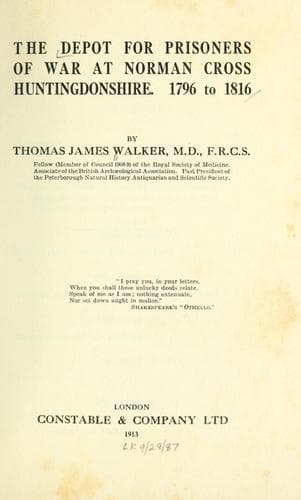
The Depot for Prisoners of War at Norman Cross, Huntingdonshire. 1796 to 1816Walker, Thomas (Thomas James)
History
The Depot for Prisoners of War at Norman Cross, Huntingdonshire. 1796 to 1816
Walker, Thomas (Thomas James)
France -- History -- 1789-1815; Norman Cross depot; Prisoners of war
“At the return of peace in 1814, hailed and welcomed as it was in
every quarter of the globe, what must have been the joy of him, who
had passed inactive wearisome years separated from his native land!
The long march homeward was never wearisome. Arrived in London, he
repaired to the Hotel, where his brother was expecting him. He had
just stepped out. Anxious and excited my husband went out too,
hoping to find him: in the meantime his brother returned, and being
told of his arrival, awaited him on the step of the door. When he
came back, the foreign look and dress at once assured his brother
that it was himself, and he stood in his way. Impatient at an
impediment to entering the house, he hastily begged him to step
aside, when the words, ‘John, do you not know me?’ told him he had
found his brother. Both were so changed that they should not have
known each other. How often, and with ever new delight, did he
recall this meeting!
“He returned home, and tho’ much, very much had happened to cloud his
happiness, the feeling of liberty so long unknown, was in his heart!
He brought home, not only from his own superior Officers, but also
from those of the French, testimonials of good conduct, having most
rigidly preserved his parole, tho’ with a fair chance of escape often
urged to break it, and having suffered by close imprisonment for the
breach of it in others.”
Mr. Hopkinson, during his imprisonment at Verdun, kept a register of his
fellow prisoners, and in his later years he filled in as far as he could
the after history of his prison comrades. This, being probably a unique
document, is, by the kind permission of his son Mr. W. Hopkinson,
reproduced in the appendix. {232} From this register it will be seen it
was not only the French prisoners at Leek and elsewhere who fought duels.
Four deaths from fatal wounds received in these affairs of honour are
recorded. The duel, one hundred years ago, was the customary and
generally acknowledged method of settling questions of honour, libels,
etc., which are now in this country settled in the law courts. As Mrs.
Hopkinson says in her note, the naval cadet never broke his parole, but
on three occasions when held captive, not by his word of honour, but by
bars and bolts, his respect for these did not prevent his attempting to
escape; for the first attempt he was confined in a cell for one month,
for his second attempt two months, and for his third, three.
Thirty-eight years after the termination of the war, Mr. Hopkinson
thought he would take his son to Verdun, to the spot where he, the lad’s
father, had spent ten years of what should have been the best period of
his life. He found the chamber in which he had been confined unaltered,
and utilised as a barrack room. Examining a bar in one of the windows,
he showed his son a cut three parts through it.
Public-domain text, read in full here on John Shaqi.
Reviews
Reviews
No reviews yet
Be the first to share your thoughts on this work.
Elsewhere in the archive
Join the Discussion
Join the discussion
Sign in to leave a comment or review.
Sign InorCreate an account