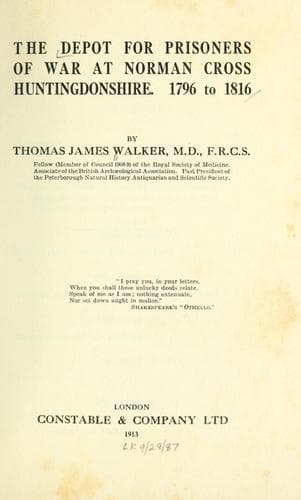
The Depot for Prisoners of War at Norman Cross, Huntingdonshire. 1796 to 1816Walker, Thomas (Thomas James)
History
The Depot for Prisoners of War at Norman Cross, Huntingdonshire. 1796 to 1816
Walker, Thomas (Thomas James)
France -- History -- 1789-1815; Norman Cross depot; Prisoners of war
THE Prisons, or Barracks, are built of fir quartering, and weather
boarded on the outside, and have no inside lining, except those
appropriated for the hospital, which are plastered. The innumerable
holes cut through all parts of the buildings by the prisoners for the
admission of light have caused them to be extremely weak, by the braces
being cut through and destroyed in many parts, so as to render it
necessary they should be immediately replaced with new, and such
regulations adopted towards the prisoners as to prevent a recurrence of
the same practice. The weather-boarding, stair-cases, hammock rails,
privies and fence are in a general bad state, as particularly stated in
this report, viz.:
_Prison No._ 1.—The ground floor is paved with stone, which is in many
parts broken and very irregular. The story posts, that support the roof
and floor, are so much damaged by being cut by the prisoners, and in
parts decayed, as to require to be new in many places. The upper floor
in the gangway, which has hitherto been laid with elm board, is stated to
require renewing every twenty months; the other parts of the floor very
much decayed. The hammock rails in many parts worn out. The braces and
quarterings of the building are very much cut and destroyed by the
prisoners, and must be new in many places. The stair-case in very bad
condition, quite worn out. As they are now constructed within the
building, they impede a free circulation of air, and occupy a space which
would allow twelve men to be berthed, in addition to the present number,
by having an accommodation ladder against the outside of the building,
with a landing place and door; this plan would stop the communication
between the two prison rooms, facilitate the escape of the prisoners in
case of fire, by having two doors instead of only one. Mr. Walker, the
surgeon, is very desirous that the same alteration should be made at the
Hospital; it would separate the two wards, which in case of infectious
diseases would be attended with beneficial effects, also save the expense
of opening another ward in case of contagion.
The weather-boarding, from the prisoners cutting holes through for the
admission of light, to each berth, as well as from actual decay, is in
such bad condition as to require at least one third to be new.
_Privy_.—The weather-boarding and wood steps in bad condition, and many
pantiles stripped from the roof. The ground under the privies on which
the soil cart stands, from the frequency of its being drawn out, has
occasioned deep ruts, so that when the cart is drawn out, it comes up
with a jerk, and the soil is thrown out, and becomes a dreadful nuisance,
which might be prevented by a few stumps of wood driven into the ground,
on which a piece of oak plank might form a railway, and the intermediate
space be filled up with stone rubbish at a very trifling expense.
Public-domain text, read in full here on John Shaqi.
Reviews
Reviews
No reviews yet
Be the first to share your thoughts on this work.
Elsewhere in the archive
Join the Discussion
Join the discussion
Sign in to leave a comment or review.
Sign InorCreate an account