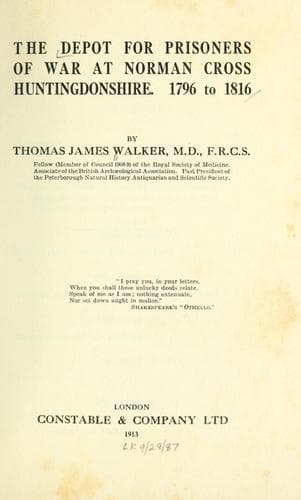
The Depot for Prisoners of War at Norman Cross, Huntingdonshire. 1796 to 1816Walker, Thomas (Thomas James)
History
The Depot for Prisoners of War at Norman Cross, Huntingdonshire. 1796 to 1816
Walker, Thomas (Thomas James)
France -- History -- 1789-1815; Norman Cross depot; Prisoners of war
Finding it impossible to save both the convoy and himself, he ordered the
convoy to make all sail to the north and escape, while he stayed and
fought for some hours.
Over fifty minutes he was engaged with the three-decker, and the fight
was under full sail as he steered to the south to enable the convoy to
escape. The superior strength and overwhelming numbers of the French
dismantled the _Calcutta_, so to prevent loss of life he hauled down his
flag and surrendered, and _The Brothers_, which was leaky and could not
escape, was also captured.
The crews were not at once landed in France, but remained on the French
ships for four months. At the end of that time they were landed at
Rochelle, and kept at an hotel for eighteen days at great expense. Then
Captain Woodriff and his officers, an East India colonel and his lady,
and two gentlemen from the East Indies, hired a carriage to take them to
Verdun. They were escorted all the way by troops; the journey lasted
thirty-six days and cost each of the prisoners £40.
In the Admiralty return of his services, there is a modest little note,
“Returned from France, June 1807,” but the circumstances attending his
return are so extraordinary as to demand attention. He had made repeated
applications to Talleyrand for release, but without avail. In June 1807,
he received an order, signed by Buonaparte, in Poland, directing him to
proceed immediately to England, and to take the route of St. Malves, a
town no Englishman was permitted to enter. On his arrival there, he
received from an agent of the French Government the letters which had
been directed to him at Verdun. He proceeded to hire a vessel to take
him to England, for which he was prepared to pay forty or fifty guineas,
but was told that a vessel was provided for him by the French Government,
free of any expense whatever.
Our Government, not to be outdone in this unexpected generosity on the
part of the enemy, immediately released a French officer of equal rank,
who returned to France on terms of equal liberality. On his return to
England Captain Woodriff was tried by court-martial for the loss of his
ship the _Calcutta_, but after evidence, “The Court agreed that the
conduct of Captain Woodriff was that of a brave, cool, and intrepid
officer; and did adjudge him, his officers, and ship’s company to be most
honourably acquitted.”
The owners and underwriters of one of the East Indiamen he had saved from
capture raised a subscription for the officers and crew, which amounted
to about £4,000.
On the 29th July 1808 Captain Woodriff was appointed Agent for Prisoners
of War at Forton.
In December 1813 he was appointed Commissioner of the navy at Jamaica.
He refused flag rank and was admitted to Greenwich Hospital, 9th November
1830, where he died 24th February 1842. {267}
Public-domain text, read in full here on John Shaqi.
Reviews
Reviews
No reviews yet
Be the first to share your thoughts on this work.
Elsewhere in the archive
Join the Discussion
Join the discussion
Sign in to leave a comment or review.
Sign InorCreate an account