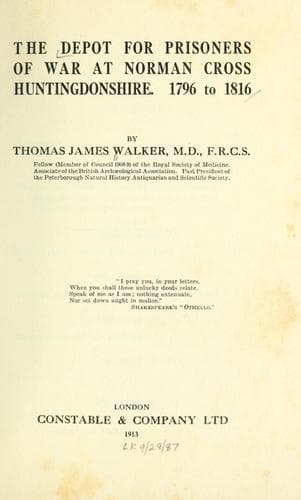
The Depot for Prisoners of War at Norman Cross, Huntingdonshire. 1796 to 1816Walker, Thomas (Thomas James)
History
The Depot for Prisoners of War at Norman Cross, Huntingdonshire. 1796 to 1816
Walker, Thomas (Thomas James)
France -- History -- 1789-1815; Norman Cross depot; Prisoners of war
Mr. George H. Walker was the surgeon to the Prison, which was in the
Parish of Yaxley, and Captain Pressland, R.N., had been for some years,
after the renewal of the war in 1803, Superintendent of the Prison, so
among all these dry details crops up the picture of our human life. We
see the young medical officer passing through the door in the Prison wall
which communicated with the Superintendent’s house (the door over which
the wall is seen rising with a ramp in the photographs of the only
fragments of the wall now remaining) to spend happy hours with Captain
Pressland’s family. We see friendship ripening into love, the story told
by the entry in the Register of St. John’s Church, Peterborough, and then
in the Register of St. Peter’s, Yaxley, we are brought face to face with
a tragedy, for the last entry of a burial from the Depot is “Captain
Thomas Pressland, Norman Cross. March 21st, 1814. 59 years. Signed, J.
Hinde, Curate,” and there can be little doubt that from the house to
which, mainly through his future father-in-law’s influence, Surgeon
Walker was able in the third year of its existence to bring Elizabeth
Colinette Pressland as his bride, while the bells of Yaxley Church rang
out a merry marriage peal, six years later passed the body of Captain
Pressland himself to be laid in Yaxley Churchyard, while the death bell
tolled its solemn note. For six years this house was the house of the
couple for whom it was built. It was in the auctioneer’s catalogue, when
it was sold on the 2nd October 1810, nothing more than “An excellent
brick dwelling-house, containing a cellar 12 ft. 6 in. by 11 ft. 2 in.,
parlour 13 ft. 3 in. by 13 ft. 8 in., etc., etc.” To us, 100 years
later, it is a part of the great tragedy of Norman Cross, and by the
light of the registers we see it in those short eight years from its
building to its destruction the scone of the brightest joys and the
deepest griefs of men and women whose names we know, whose persons we can
imagine, and who help to clothe those cold, dry records with the warmth
of human life.
{28a} On a range of the stabling purchased in 1816 to be re-erected as
farm buildings in a neighbouring village, over one of the doors there
stands out in bold relief, owing to the protective influence of the
paint, the letters B. A. T., and in the auctioneer’s catalogue the Range
is described as Bathorse Stable Range. From Stœqueler’s _Military
Encyclopædia_, we learn that “Bat” signified a pack saddle; “Bathorse,”
one which carried a pack; “Batman,” the man in charge of the Bathorse.
The latter term came to be used for an officer’s servant, while the
Bathorse Stable was applied to a military stable for draught and other
horses.
Public-domain text, read in full here on John Shaqi.
Reviews
Reviews
No reviews yet
Be the first to share your thoughts on this work.
Elsewhere in the archive
Join the Discussion
Join the discussion
Sign in to leave a comment or review.
Sign InorCreate an account