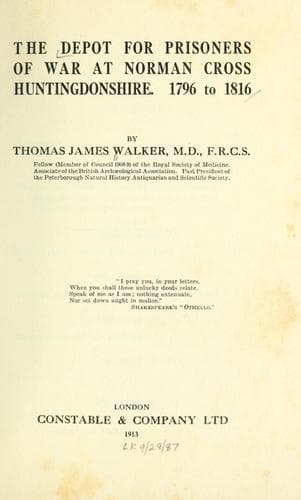
The Depot for Prisoners of War at Norman Cross, Huntingdonshire. 1796 to 1816Walker, Thomas (Thomas James)
History
The Depot for Prisoners of War at Norman Cross, Huntingdonshire. 1796 to 1816
Walker, Thomas (Thomas James)
France -- History -- 1789-1815; Norman Cross depot; Prisoners of war
“My grandfather, Samuel Briggs, of Ailsworth, was constable; he was
also in the Militia, and was told off to keep guard on Thorpe Road,
at the entrance to Peterboro’, on the escape of some prisoners, but
who went the way to Ramsay. I have a box made by the prisoners,
presented to my grandfather, who was also a carpenter, and at times
went to work there. The prisoners used to beg pieces of wood and
other materials of him. He used to speak of their cleverness in the
making of fancy articles, and of their endeavours to escape—one got
in the manure cart, and got away.”
{70} When Greens are issued in lieu of Pease, one pound stripped of the
outer leaves and fit for the copper shall be issued to each prisoner.
Each prisoner shall receive two ounces of Soap per week.
{71} Knowing how dogs as a rule refuse to eat meat impregnated with
herbs and condiments, we probably have here the explanation of little
George Borrow’s impression of the food of the prisoners, which forty
years later made him write of it, “Rations of Carrion meat and bread from
which I have seen the very hounds occasionally turn away.” Every one who
knows the habit of dogs, knows that many of them would turn away from the
meat which had been boiled for four or five hours with a broth
impregnated with herbs.
{74a} In the light of modern science, we can well understand the origin
of the accusation by the British that the wells had been purposely
poisoned in order to kill the English prisoners. Enteric fever had not
then been differentiated from typhus, the mode of its spread was unknown,
and probably defective sanitation had led to poisoning of the well, as it
has done and still is doing in many a British town and village.
{74b} Correspondence with the French Government relative to Prisoners of
War Supplement, 1801, to Appendix No. 59. Report of the Transport Board
to the House of Commons, 1798.
{75} This will be dealt with in the following chapter.
{76} Report of the Transport Board to the House of Commons, 1798,
Appendix No. 59—Most valuable information on the merits of the dispute
between the two Governments has been obtained from the Report and its
Appendix, and from an imperfect copy of a Supplement to the Appendix,
issued from Downing Street, 6th Jan. 1801. This supplement is not to be
found either in the Library of the House of Commons or in the British
Museum, and the Fragment which contained thirty-nine out of fifty-three
letters indexed in the table of contents, in the course of its travels
through my hands and my agents’ and the typewriters’, has been lost.
This loss is irreparable, but I am able to publish in the text or in the
Appendix five of the fifty-three letters which were printed in this
supplement to the report. Appendix D.
{77} AFFIDAVITS OF PERROT, THE ENGLISH AND FRENCH SURGEON
Public-domain text, read in full here on John Shaqi.
Reviews
Reviews
No reviews yet
Be the first to share your thoughts on this work.
Elsewhere in the archive
Join the Discussion
Join the discussion
Sign in to leave a comment or review.
Sign InorCreate an account