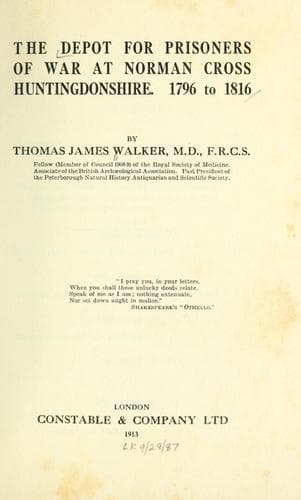
The Depot for Prisoners of War at Norman Cross, Huntingdonshire. 1796 to 1816Walker, Thomas (Thomas James)
History
The Depot for Prisoners of War at Norman Cross, Huntingdonshire. 1796 to 1816
Walker, Thomas (Thomas James)
France -- History -- 1789-1815; Norman Cross depot; Prisoners of war
{129} In the great action off Cape Trafalgar on 21st October 1805, the
_Leviathan_, seventy-four guns, under Captain Bayton, was next to the
_Victory_. After passing through the enemy’s line she dismasted her
opponent, raked the _Santissima Trinidad_, and passed on to the _San
Augustin_, one of seven coming to surround her; this ship was silenced in
fifteen minutes, and the crew of the _Leviathan_, making her fast with a
hawser, towed her into the English Fleet with the English Jack flying.
The French ship _L’Intrépide_ had by distant firing cut into the sails
and rigging of the _Leviathan_, but three more British ships coming up,
_L’Intrépide_ was, after a noble resistance, also compelled to surrender,
and was set on fire by the _Britannia_. The crews were landed at
Portsmouth and transferred to Norman Cross, where they were received on
8th January 1806. One was Corporal Jean De la Porte, whose name appears
as the maker of signed straw marquetry pictures, and to whom are
attributed many other unsigned pictures of the same character. Mr. Jean
De la Porte is spoken of as an officer; had he been of that rank he would
not have been in the prison, but out on parole. He was a Petty Officer,
and would be in the Petty Officers’ prison. He was confined at Norman
Cross for nearly nine years, and during this long captivity his artistic
skill and taste must have enormously mitigated his suffering.
{131a} _On Horn and Tortoiseshell_, by H. Akin, late Secretary of the
Society of Arts, London. _Journal of the Franklin Institute_, _London_.
Series vol. xxvi., pp. 256–9. 1840.
{131b} I have a drinking-horn, given to me by the daughter-in-law of the
man for whom it was made, engraved with his name—J. Bates—surrounded by a
floral pattern.—T. J. W.
{133a} This art was practised by amateurs in the 18th century. In 1875
an attempt was made to reintroduce the work. “Mosaicon, or Paper
Mosaic,” W. Bemrose, jun. (Bemrose & Sons, 10, Paternoster Buildings,
E.C., and Irongate, Derby.)
Public-domain text, read in full here on John Shaqi.
Reviews
Reviews
No reviews yet
Be the first to share your thoughts on this work.
Elsewhere in the archive
Join the Discussion
Join the discussion
Sign in to leave a comment or review.
Sign InorCreate an account