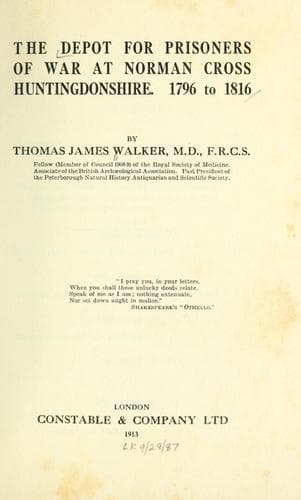
The Depot for Prisoners of War at Norman Cross, Huntingdonshire. 1796 to 1816Walker, Thomas (Thomas James)
History
The Depot for Prisoners of War at Norman Cross, Huntingdonshire. 1796 to 1816
Walker, Thomas (Thomas James)
France -- History -- 1789-1815; Norman Cross depot; Prisoners of war
“Le Soussigné Agent du Gouvernement Britannique Chargé du soin et de
la Surveillance des Prisonniers de Guerre au Dépôt de Norman Cross,
Certifie que le Nommé Vincent Fontaine, natif de Veli, Pris à Bord du
transport _La Sophie_, en qualité de soldat, entre en Prison au Dépôt
de Norman Cross le 25 Septembre 1804, est mort à l’hospital du susdit
Dépôt le Vingt trois mars, mil huit cent huit, âgé de Trente ans et
demi, ainsi qu’il couste par les Registres de la Prison.
“En foi de quoi j’ai délivré le Présent Extrait pour servir à qui de
Raison.
“Norman Cross le 1er Juin 1814.
“(Signed) W. HANWELL, Capt. R.N., Agent.”
[_Translation_]
“The Undersigned Agent of the British Government in charge of the
care and the superintendence of the Prisoners of War at the Depot of
the Norman Cross, certifies that the named Vincent Fontaine, native
of Veli, taken on board the transport _La Sophie_, as being a
soldier, entered into the Prison at the Depot of Norman Cross on the
25th September 1804, died in the Hospital of the above-mentioned
Depot, 23rd March 1808, Age 30½ years, as shown by the Prison
Registers.
“In Witness whereof I have delivered the present Extract to be used
by Whom it may concern.
“Norman Cross, 1st June 1814.
“(Signed) W. HANWELL, Capt. R.N., Agent.”
Vincent Fontaine was the only prisoner who died during the week ending
27th March 1808. The certificate was signed by Thos. Pressland, the
agent at that date.
{177} _Notes and Queries_, Ser. ii., v. 204.
{180a} Appendix G.—Letter enclosing short autobiography from the Bishop
of Moulins to Earl Fitzwilliam. Reply from Earl Fitzwilliam and
correspondence between his lordship and Lord Mulgrave, etc.
{180b} _The French Prisoners of Norman Cross_. A tale by the Rev.
Arthur Brown, Rector of Catfield, Norfolk. (Hodder Brothers.)
{181} This house is selected by tradition as that of the Bishop, being
the one most suited to a wealthy ecclesiastic of high rank. The Bishop’s
letters are dated from the Bell Inn, where he probably could live, _en
pension_, on what was left out of his £240 a year, after paying the
interest due to the money-lenders.
{182} This was a remarkable election, and created immense excitement at
the time. There had been no contested election for forty-six years, and
in 1807 there were four candidates for the two seats. One, a Mr. Fowkes,
received two votes. William Wilberforce, the great advocate for the
abolition of slavery, led all the way; the real contest was between
Milton and Lascelles. Wilberforce’s expenses were largely met by
subscription; the cost to the other two was enormous. _The Recorder_ of
Leeds said, “The yellow had not only been in the hats, but had also been
in the pockets of the voters for Lord Milton.” The state of the poll at
the end was:
Public-domain text, read in full here on John Shaqi.
Reviews
Reviews
No reviews yet
Be the first to share your thoughts on this work.
Elsewhere in the archive
Join the Discussion
Join the discussion
Sign in to leave a comment or review.
Sign InorCreate an account