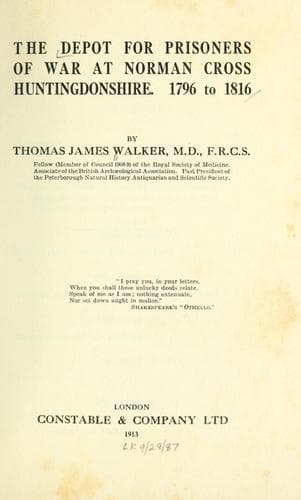
The Depot for Prisoners of War at Norman Cross, Huntingdonshire. 1796 to 1816Walker, Thomas (Thomas James)
History
The Depot for Prisoners of War at Norman Cross, Huntingdonshire. 1796 to 1816
Walker, Thomas (Thomas James)
France -- History -- 1789-1815; Norman Cross depot; Prisoners of war
{250} At this time Norman Cross and the other existing prisons were
greatly overcrowded, but Wellington found it impossible to guard and
maintain his prisoners on the Continent. Not only were the troops
actually captured overwhelmingly numerous, but to their number were added
deserters. In one of his dispatches, he writes: “Two battalions of the
Regiment of Nassau, and one of Frankfort having quitted the enemies’ Army
and passed over to that under my command. . . . I now send these troops
to England.” The long-delayed completion of the prisons at Dartmoor and
Perth would relieve the overcrowding of Norman Cross; but the resources
of the staff must, in the meantime, have been strained to an extreme
point to prevent the evils which might result from the state of matters.
The breakdown of the various negotiations for exchange prevented the
relief which was afforded during the first period of the war by the
steady drain of prisoners sent back to their own country.
{252} It is said that a memorandum exists in a private diary that the
price paid for a picture of straw marquetry of Peterborough Cathedral was
only £2; the picture must have taken weeks to construct.
{253a} The prison register confirms this paragraph. The last death
certificate is that of Petronio Lambertini, a soldier of the Italian
Regiment of the French Army. He died of consumption, and was presumably
the last prisoner buried in the cemetery adjoining the North Road.
{253b} _Loc. cit._, p. 120.
{254} The copy of the catalogue used by the auctioneer, with his note of
the purchaser of and the price paid for each lot, is for the time in the
writer’s hands, and has afforded much information, especially as to the
construction of the buildings and the use to which each was appropriated.
Two years before this sale took place the Depot had been evacuated, and
in the Public Record Office is the Barrack Master’s receipt to Captain
Hanwell, dated 30th October 1814, for the Depot at Norman Cross,
delivered over to him, agreeably to the Transport Board’s order of 24th
September 1814. The document consists of ten pages in double columns.
{267} _Admiralty Records_, _Transport Department_, _Minutes No._ 38;
_Records of Captains’ Services_, O’ Byrne; _Naval Biographical
Dictionary_; _Naval Chronicle_, vol. viii., 438; xiv., 283; xvi., 107,
108; xviii., 28; xix., 170–2; _The Times_, 26th February 1842.
{276} M. Otto had at the date of this letter succeeded M. Niou as
Commissary for the French Prisoners of War confined in Great Britain.
{283} This was written three months before the fatal epidemic broke out
in the prison.—T. J. W.
{286a} The number stated to be sick, on the 30th April 1810, includes
convalescents, cases of wounds, accidents, etc.
{286b} _Parliamentary Papers_, 1810–11, vol. xi. (263), p. 115.
{312} This is not a facsimile copy of the Register, which contains many
abbreviations; it has been set out in columns, and abbreviated words have
been written in full.
Public-domain text, read in full here on John Shaqi.
Reviews
Reviews
No reviews yet
Be the first to share your thoughts on this work.
Elsewhere in the archive
Join the Discussion
Join the discussion
Sign in to leave a comment or review.
Sign InorCreate an account