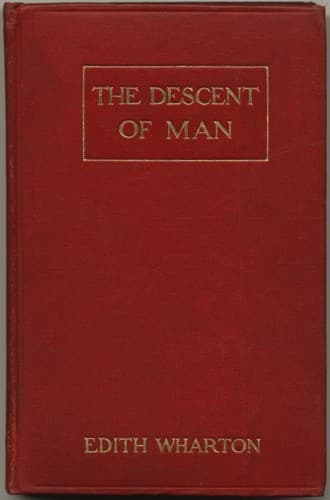
The Descent of Man and Other StoriesWharton, Edith
General
The Descent of Man and Other Stories
Wharton, Edith
New York (N.Y.) -- Social life and customs -- Fiction; Short stories
On the Fenno threshold a sudden sense of the futility of the attempt
had almost driven Mrs. Quentin back to her carriage; but the door was
already opening, and a parlor-maid who believed that Miss Fenno was in
led the way to the depressing drawing-room. It was the kind of room in
which no member of the family is likely to be found except after dinner
or after death. The chairs and tables looked like poor relations who
had repaid their keep by a long career of grudging usefulness: they
seemed banded together against intruders in a sullen conspiracy of
discomfort. Mrs. Quentin, keenly susceptible to such influences, read
failure in every angle of the upholstery. She was incapable of the
vulgar error of thinking that Hope Fenno might be induced to marry Alan
for his money; but between this assumption and the inference that the
girl's imagination might be touched by the finer possibilities of
wealth, good taste admitted a distinction. The Fenno furniture,
however, presented to such reasoning the obtuseness of its black-walnut
chamferings; and something in its attitude suggested that its owners
would be as uncompromising. The room showed none of the modern attempts
at palliation, no apologetic draping of facts; and Mrs. Quentin,
provisionally perched on a green-reps Gothic sofa with which it was
clearly impossible to establish any closer relations, concluded that,
had Mrs. Fenno needed another seat of the same size, she would have set
out placidly to match the one on which her visitor now languished.
To Mrs. Quentin's fancy, Hope Fenno's opinions, presently imparted in a
clear young voice from the opposite angle of the Gothic sofa, partook
of the character of their surroundings. The girl's mind was like a
large light empty place, scantily furnished with a few massive
prejudices, not designed to add to any one's comfort but too ponderous
to be easily moved. Mrs. Quentin's own intelligence, in which its
owner, in an artistically shaded half-light, had so long moved amid a
delicate complexity of sensations, seemed in comparison suddenly close
and crowded; and in taking refuge there from the glare of the young
girl's candor, the older woman found herself stumbling in an unwonted
obscurity. Her uneasiness resolved itself into a sense of irritation
against her listener. Mrs. Quentin knew that the momentary value of any
argument lies in the capacity of the mind to which it is addressed, and
as her shafts of persuasion spent themselves against Miss Fenno's
obduracy, she said to herself that, since conduct is governed by
emotions rather than ideas, the really strong people are those who
mistake their sensations for opinions. Viewed in this light, Miss Fenno
was certainly very strong: there was an unmistakable ring of finality
in the tone with which she declared,
"It's impossible."
Mrs. Quentin's answer veiled the least shade of feminine resentment. "I
told Alan that, where he had failed, there was no chance of my making
an impression."
Public-domain text, read in full here on John Shaqi.
Reviews
Reviews
No reviews yet
Be the first to share your thoughts on this work.
Elsewhere in the archive
Join the Discussion
Join the discussion
Sign in to leave a comment or review.
Sign InorCreate an account