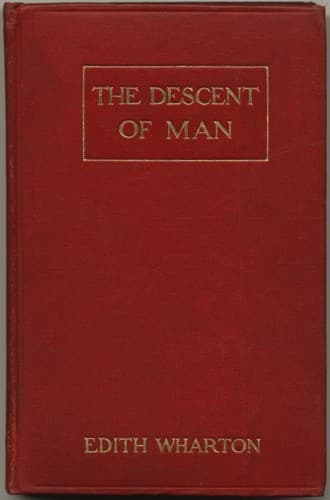
The Descent of Man and Other StoriesWharton, Edith
General
The Descent of Man and Other Stories
Wharton, Edith
New York (N.Y.) -- Social life and customs -- Fiction; Short stories
"My husband said nothing, but he must have seen how things were going.
There was no more talk of giving up the _Radiator_. He never reproached
me with my inconsistency, but I thought he must despise me, and the
thought made me reckless. I determined to ignore the paper
altogether--to take what it gave as though I didn't know where it came
from. And to excuse this I invented the theory that one may, so to
speak, purify money by putting it to good uses. I gave away a great
deal in charity--I indulged myself very little at first. All the money
that was not spent on Alan I tried to do good with. But gradually, as
my boy grew up, the problem became more complicated. How was I to
protect Alan from the contamination I had let him live in? I couldn't
preach by example--couldn't hold up his father as a warning, or
denounce the money we were living on. All I could do was to disguise
the inner ugliness of life by making it beautiful outside--to build a
wall of beauty between him and the facts of life, turn his tastes and
interests another way, hide the _Radiator_ from him as a smiling woman
at a ball may hide a cancer in her breast! Just as Alan was entering
college his father died. Then I saw my way clear. I had loved my
husband--and yet I drew my first free breath in years. For the
_Radiator_ had been left to Alan outright--there was nothing on earth
to prevent his selling it when he came of age. And there was no excuse
for his not selling it. I had brought him up to depend on money, but
the paper had given us enough money to gratify all his tastes. At last
we could turn on the monster that had nourished us. I felt a savage joy
in the thought--I could hardly bear to wait till Alan came of age. But
I had never spoken to him of the paper, and I didn't dare speak of it
now. Some false shame kept me back, some vague belief in his ignorance.
I would wait till he was twenty-one, and then we should be free.
"I waited--the day came, and I spoke. You can guess his answer, I
suppose. He had no idea of selling the _Radiator_. It wasn't the money
he cared for--it was the career that tempted him. He was a born
journalist, and his ambition, ever since he could remember, had been to
carry on his father's work, to develop, to surpass it. There was
nothing in the world as interesting as modern journalism. He couldn't
imagine any other kind of life that wouldn't bore him to death. A
newspaper like the _Radiator_ might be made one of the biggest powers
on earth, and he loved power, and meant to have all he could get. I
listened to him in a kind of trance. I couldn't find a word to say. His
father had had scruples--he had none. I seemed to realize at once that
argument would be useless. I don't know that I even tried to plead with
him--he was so bright and hard and inaccessible! Then I saw that he
was, after all, what I had made him--the creature of my concessions, my
connivances, my evasions. That was the price I had paid for him--I had
kept him at that cost!
Public-domain text, read in full here on John Shaqi.
Reviews
Reviews
No reviews yet
Be the first to share your thoughts on this work.
Elsewhere in the archive
Join the Discussion
Join the discussion
Sign in to leave a comment or review.
Sign InorCreate an account