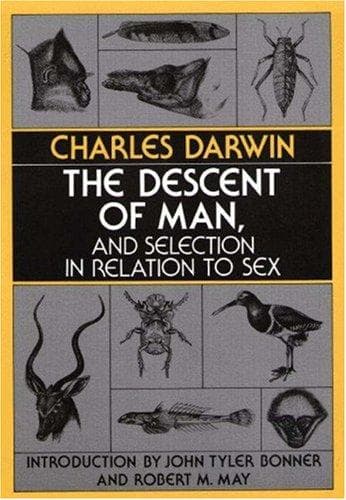
The Descent of Man, and Selection in Relation to SexDarwin, Charles
History
The Descent of Man, and Selection in Relation to Sex
Darwin, Charles
Evolution (Biology); Human beings -- Origin; Sex differences; Sexual dimorphism (Animals); Sexual selection in animals
It must be called sympathy that leads a courageous dog to fly at any
one who strikes his master, as he certainly will. I saw a person
pretending to beat a lady, who had a very timid little dog on her lap,
and the trial had never been made before; the little creature instantly
jumped away, but after the pretended beating was over, it was really
pathetic to see how perseveringly he tried to lick his mistress’s face,
and comfort her. Brehm (15. ‘Thierleben,’ B. i. s. 85.) states that
when a baboon in confinement was pursued to be punished, the others
tried to protect him. It must have been sympathy in the cases above
given which led the baboons and Cercopitheci to defend their young
comrades from the dogs and the eagle. I will give only one other
instance of sympathetic and heroic conduct, in the case of a little
American monkey. Several years ago a keeper at the Zoological Gardens
shewed me some deep and scarcely healed wounds on the nape of his own
neck, inflicted on him, whilst kneeling on the floor, by a fierce
baboon. The little American monkey, who was a warm friend of this
keeper, lived in the same large compartment, and was dreadfully afraid
of the great baboon. Nevertheless, as soon as he saw his friend in
peril, he rushed to the rescue, and by screams and bites so distracted
the baboon that the man was able to escape, after, as the surgeon
thought, running great risk of his life.
Besides love and sympathy, animals exhibit other qualities connected
with the social instincts, which in us would be called moral; and I
agree with Agassiz (16. ‘De l’Espèce et de la Classe,’ 1869, p. 97.)
that dogs possess something very like a conscience.
Dogs possess some power of self-command, and this does not appear to be
wholly the result of fear. As Braubach (17. ‘Die Darwin’sche
Art-Lehre,’ 1869, s. 54.) remarks, they will refrain from stealing food
in the absence of their master. They have long been accepted as the
very type of fidelity and obedience. But the elephant is likewise very
faithful to his driver or keeper, and probably considers him as the
leader of the herd. Dr. Hooker informs me that an elephant, which he
was riding in India, became so deeply bogged that he remained stuck
fast until the next day, when he was extricated by men with ropes.
Under such circumstances elephants will seize with their trunks any
object, dead or alive, to place under their knees, to prevent their
sinking deeper in the mud; and the driver was dreadfully afraid lest
the animal should have seized Dr. Hooker and crushed him to death. But
the driver himself, as Dr. Hooker was assured, ran no risk. This
forbearance under an emergency so dreadful for a heavy animal, is a
wonderful proof of noble fidelity. (18. See also Hooker’s ‘Himalayan
Journals,’ vol. ii. 1854, p. 333.)
Public-domain text, read in full here on John Shaqi.
Reviews
Reviews
No reviews yet
Be the first to share your thoughts on this work.
Elsewhere in the archive
Join the Discussion
Join the discussion
Sign in to leave a comment or review.
Sign InorCreate an account