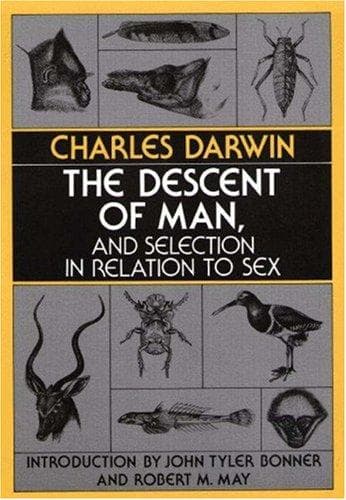
The Descent of Man, and Selection in Relation to SexDarwin, Charles
History
The Descent of Man, and Selection in Relation to Sex
Darwin, Charles
Evolution (Biology); Human beings -- Origin; Sex differences; Sexual dimorphism (Animals); Sexual selection in animals
world we know not; nor can we tell how some real and great crimes, such
as incest, have come to be held in an abhorrence (which is not however
quite universal) by the lowest savages. It is even doubtful whether in
some tribes incest would be looked on with greater horror, than would
the marriage of a man with a woman bearing the same name, though not a
relation. “To violate this law is a crime which the Australians hold in
the greatest abhorrence, in this agreeing exactly with certain tribes
of North America. When the question is put in either district, is it
worse to kill a girl of a foreign tribe, or to marry a girl of one’s
own, an answer just opposite to ours would be given without
hesitation.” (29. E.B. Tylor, in ‘Contemporary Review,’ April 1873, p.
707.) We may, therefore, reject the belief, lately insisted on by some
writers, that the abhorrence of incest is due to our possessing a
special God-implanted conscience. On the whole it is intelligible, that
a man urged by so powerful a sentiment as remorse, though arising as
above explained, should be led to act in a manner, which he has been
taught to believe serves as an expiation, such as delivering himself up
to justice.
Man prompted by his conscience, will through long habit acquire such
perfect self-command, that his desires and passions will at last yield
instantly and without a struggle to his social sympathies and
instincts, including his feeling for the judgment of his fellows. The
still hungry, or the still revengeful man will not think of stealing
food, or of wreaking his vengeance. It is possible, or as we shall
hereafter see, even probable, that the habit of self-command may, like
other habits, be inherited. Thus at last man comes to feel, through
acquired and perhaps inherited habit, that it is best for him to obey
his more persistent impulses. The imperious word “ought” seems merely
to imply the consciousness of the existence of a rule of conduct,
however it may have originated. Formerly it must have been often
vehemently urged that an insulted gentleman OUGHT to fight a duel. We
even say that a pointer OUGHT to point, and a retriever to retrieve
game. If they fail to do so, they fail in their duty and act wrongly.
Public-domain text, read in full here on John Shaqi.
Reviews
Reviews
No reviews yet
Be the first to share your thoughts on this work.
Elsewhere in the archive
Join the Discussion
Join the discussion
Sign in to leave a comment or review.
Sign InorCreate an account