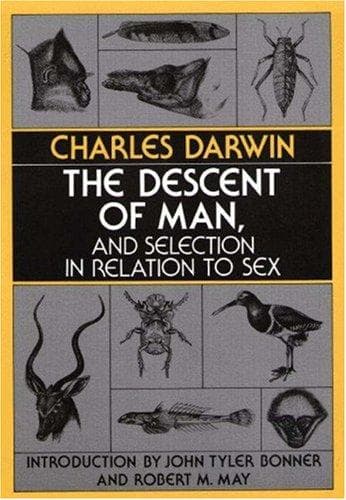
The Descent of Man, and Selection in Relation to SexDarwin, Charles
History
The Descent of Man, and Selection in Relation to Sex
Darwin, Charles
Evolution (Biology); Human beings -- Origin; Sex differences; Sexual dimorphism (Animals); Sexual selection in animals
If the anthropomorphous apes be admitted to form a natural sub-group,
then as man agrees with them, not only in all those characters which he
possesses in common with the whole Catarrhine group, but in other
peculiar characters, such as the absence of a tail and of callosities,
and in general appearance, we may infer that some ancient member of the
anthropomorphous sub-group gave birth to man. It is not probable that,
through the law of analogous variation, a member of one of the other
lower sub-groups should have given rise to a man-like creature,
resembling the higher anthropomorphous apes in so many respects. No
doubt man, in comparison with most of his allies, has undergone an
extraordinary amount of modification, chiefly in consequence of the
great development of his brain and his erect position; nevertheless, we
should bear in mind that he “is but one of several exceptional forms of
Primates.” (14. Mr. St. G. Mivart, ‘Transactions of the Philosophical
Society,’ 1867, p. 410.)
Every naturalist, who believes in the principle of evolution, will
grant that the two main divisions of the Simiadae, namely the
Catarrhine and Platyrrhine monkeys, with their sub-groups, have all
proceeded from some one extremely ancient progenitor. The early
descendants of this progenitor, before they had diverged to any
considerable extent from each other, would still have formed a single
natural group; but some of the species or incipient genera would have
already begun to indicate by their diverging characters the future
distinctive marks of the Catarrhine and Platyrrhine divisions. Hence
the members of this supposed ancient group would not have been so
uniform in their dentition, or in the structure of their nostrils, as
are the existing Catarrhine monkeys in one way and the Platyrrhines in
another way, but would have resembled in this respect the allied
Lemuridae, which differ greatly from each other in the form of their
muzzles (15. Messrs. Murie and Mivart on the Lemuroidea, ‘Transactions,
Zoological Society,’ vol. vii, 1869, p. 5.), and to an extraordinary
degree in their dentition.
Public-domain text, read in full here on John Shaqi.
Reviews
Reviews
No reviews yet
Be the first to share your thoughts on this work.
Elsewhere in the archive
Join the Discussion
Join the discussion
Sign in to leave a comment or review.
Sign InorCreate an account