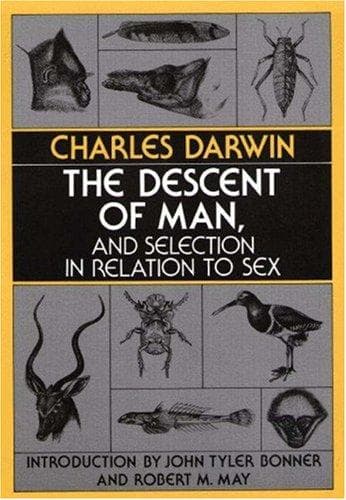
The Descent of Man, and Selection in Relation to SexDarwin, Charles
History
The Descent of Man, and Selection in Relation to Sex
Darwin, Charles
Evolution (Biology); Human beings -- Origin; Sex differences; Sexual dimorphism (Animals); Sexual selection in animals
The Marsupials stand in many important characters below the placental
mammals. They appeared at an earlier geological period, and their range
was formerly much more extensive than at present. Hence the Placentata
are generally supposed to have been derived from the Implacentata or
Marsupials; not, however, from forms closely resembling the existing
Marsupials, but from their early progenitors. The Monotremata are
plainly allied to the Marsupials, forming a third and still lower
division in the great mammalian series. They are represented at the
present day solely by the Ornithorhynchus and Echidna; and these two
forms may be safely considered as relics of a much larger group,
representatives of which have been preserved in Australia through some
favourable concurrence of circumstances. The Monotremata are eminently
interesting, as leading in several important points of structure
towards the class of reptiles.
In attempting to trace the genealogy of the Mammalia, and therefore of
man, lower down in the series, we become involved in greater and
greater obscurity; but as a most capable judge, Mr. Parker, has
remarked, we have good reason to believe, that no true bird or reptile
intervenes in the direct line of descent. He who wishes to see what
ingenuity and knowledge can effect, may consult Prof. Haeckel’s works.
(21. Elaborate tables are given in his ‘Generelle Morphologie’ (B. ii.
s. cliii. and s. 425); and with more especial reference to man in his
‘Natürliche Schöpfungsgeschichte,’ 1868. Prof. Huxley, in reviewing
this latter work (‘The Academy,’ 1869, p. 42) says, that he considers
the phylum or lines of descent of the Vertebrata to be admirably
discussed by Haeckel, although he differs on some points. He expresses,
also, his high estimate of the general tenor and spirit of the whole
work.) I will content myself with a few general remarks. Every
evolutionist will admit that the five great vertebrate classes, namely,
mammals, birds, reptiles, amphibians, and fishes, are descended from
some one prototype; for they have much in common, especially during
their embryonic state. As the class of fishes is the most lowly
organised, and appeared before the others, we may conclude that all the
members of the vertebrate kingdom are derived from some fishlike
animal. The belief that animals so distinct as a monkey, an elephant, a
humming-bird, a snake, a frog, and a fish, etc., could all have sprung
from the same parents, will appear monstrous to those who have not
attended to the recent progress of natural history. For this belief
implies the former existence of links binding closely together all
these forms, now so utterly unlike.
Public-domain text, read in full here on John Shaqi.
Reviews
Reviews
No reviews yet
Be the first to share your thoughts on this work.
Elsewhere in the archive
Join the Discussion
Join the discussion
Sign in to leave a comment or review.
Sign InorCreate an account