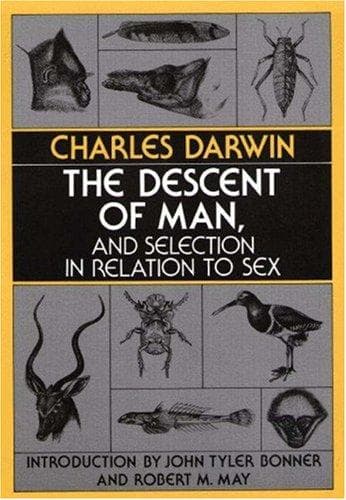
The Descent of Man, and Selection in Relation to SexDarwin, Charles
History
The Descent of Man, and Selection in Relation to Sex
Darwin, Charles
Evolution (Biology); Human beings -- Origin; Sex differences; Sexual dimorphism (Animals); Sexual selection in animals
Extinction follows chiefly from the competition of tribe with tribe,
and race with race. Various checks are always in action, serving to
keep down the numbers of each savage tribe,—such as periodical famines,
nomadic habits and the consequent deaths of infants, prolonged
suckling, wars, accidents, sickness, licentiousness, the stealing of
women, infanticide, and especially lessened fertility. If any one of
these checks increases in power, even slightly, the tribe thus affected
tends to decrease; and when of two adjoining tribes one becomes less
numerous and less powerful than the other, the contest is soon settled
by war, slaughter, cannibalism, slavery, and absorption. Even when a
weaker tribe is not thus abruptly swept away, if it once begins to
decrease, it generally goes on decreasing until it becomes extinct.
(32. Gerland (ibid. s. 12) gives facts in support of this statement.)
When civilised nations come into contact with barbarians the struggle
is short, except where a deadly climate gives its aid to the native
race. Of the causes which lead to the victory of civilised nations,
some are plain and simple, others complex and obscure. We can see that
the cultivation of the land will be fatal in many ways to savages, for
they cannot, or will not, change their habits. New diseases and vices
have in some cases proved highly destructive; and it appears that a new
disease often causes much death, until those who are most susceptible
to its destructive influence are gradually weeded out (33. See remarks
to this effect in Sir H. Holland’s ‘Medical Notes and Reflections,’
1839, p. 390.); and so it may be with the evil effects from spirituous
liquors, as well as with the unconquerably strong taste for them shewn
by so many savages. It further appears, mysterious as is the fact, that
the first meeting of distinct and separated people generates disease.
(34. I have collected (‘Journal of Researches: Voyage of the “Beagle,”’
p. 435) a good many cases bearing on this subject; see also Gerland,
ibid. s. 8. Poeppig speaks of the “breath of civilisation as poisonous
to savages.”) Mr. Sproat, who in Vancouver Island closely attended to
the subject of extinction, believed that changed habits of life,
consequent on the advent of Europeans, induces much ill health. He
lays, also, great stress on the apparently trifling cause that the
natives become “bewildered and dull by the new life around them; they
lose the motives for exertion, and get no new ones in their place.”
(35. Sproat, ‘Scenes and Studies of Savage Life,’ 1868, p. 284.)
Public-domain text, read in full here on John Shaqi.
Reviews
Reviews
No reviews yet
Be the first to share your thoughts on this work.
Elsewhere in the archive
Join the Discussion
Join the discussion
Sign in to leave a comment or review.
Sign InorCreate an account