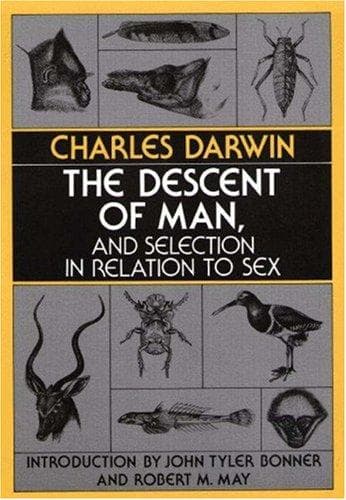
The Descent of Man, and Selection in Relation to SexDarwin, Charles
History
The Descent of Man, and Selection in Relation to Sex
Darwin, Charles
Evolution (Biology); Human beings -- Origin; Sex differences; Sexual dimorphism (Animals); Sexual selection in animals
received from Bishop Staley, it does not appear that the poorer classes
have ever much changed their diet, although many new kinds of fruit
have been introduced, and the sugar-cane is in universal use. Owing,
however, to their passion for imitating Europeans, they altered their
manner of dressing at an early period, and the use of alcoholic drinks
became very general. Although these changes appear inconsiderable, I
can well believe, from what is known with respect to animals, that they
might suffice to lessen the fertility of the natives. (43. The
foregoing statements are taken chiefly from the following works:
Jarves’ ‘History of the Hawaiian Islands,’ 1843, pp. 400-407. Cheever,
‘Life in the Sandwich Islands,’ 1851, p. 277. Ruschenberger is quoted
by Bonwick, ‘Last of the Tasmanians,’ 1870, p. 378. Bishop is quoted by
Sir E. Belcher, ‘Voyage Round the World,’ 1843, vol. i. p. 272. I owe
the census of the several years to the kindness of Mr. Coan, at the
request of Dr. Youmans of New York; and in most cases I have compared
the Youmans figures with those given in several of the above-named
works. I have omitted the census for 1850, as I have seen two widely
different numbers given.)
Lastly, Mr. Macnamara states (44. ‘The Indian Medical Gazette,’ Nov. 1,
1871, p. 240.) that the low and degraded inhabitants of the Andaman
Islands, on the eastern side of the Gulf of Bengal, are “eminently
susceptible to any change of climate: in fact, take them away from
their island homes, and they are almost certain to die, and that
independently of diet or extraneous influences.” He further states that
the inhabitants of the Valley of Nepal, which is extremely hot in
summer, and also the various hill-tribes of India, suffer from
dysentery and fever when on the plains; and they die if they attempt to
pass the whole year there.
We thus see that many of the wilder races of man are apt to suffer much
in health when subjected to changed conditions or habits of life, and
not exclusively from being transported to a new climate. Mere
alterations in habits, which do not appear injurious in themselves,
seem to have this same effect; and in several cases the children are
particularly liable to suffer. It has often been said, as Mr. Macnamara
remarks, that man can resist with impunity the greatest diversities of
climate and other changes; but this is true only of the civilised
races. Man in his wild condition seems to be in this respect almost as
susceptible as his nearest allies, the anthropoid apes, which have
never yet survived long, when removed from their native country.
Public-domain text, read in full here on John Shaqi.
Reviews
Reviews
No reviews yet
Be the first to share your thoughts on this work.
Elsewhere in the archive
Join the Discussion
Join the discussion
Sign in to leave a comment or review.
Sign InorCreate an account