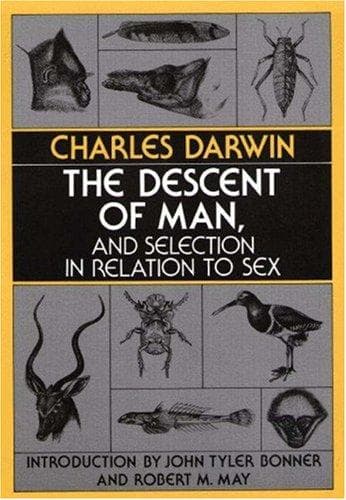
The Descent of Man, and Selection in Relation to SexDarwin, Charles
History
The Descent of Man, and Selection in Relation to Sex
Darwin, Charles
Evolution (Biology); Human beings -- Origin; Sex differences; Sexual dimorphism (Animals); Sexual selection in animals
A much more probable view is suggested by the analogy of the lower
animals. The reproductive system can be shewn to be susceptible to an
extraordinary degree (though why we know not) to changed conditions of
life; and this susceptibility leads both to beneficial and to evil
results. A large collection of facts on this subject is given in chap.
xviii. of vol. ii. of my ‘Variation of Animals and Plants under
Domestication.’ I can here give only the briefest abstract; and every
one interested in the subject may consult the above work. Very slight
changes increase the health, vigour, and fertility of most or all
organic beings, whilst other changes are known to render a large number
of animals sterile. One of the most familiar cases, is that of tamed
elephants not breeding in India; though they often breed in Ava, where
the females are allowed to roam about the forests to some extent, and
are thus placed under more natural conditions. The case of various
American monkeys, both sexes of which have been kept for many years
together in their own countries, and yet have very rarely or never
bred, is a more apposite instance, because of their relationship to
man. It is remarkable how slight a change in the conditions often
induces sterility in a wild animal when captured; and this is the more
strange as all our domesticated animals have become more fertile than
they were in a state of nature; and some of them can resist the most
unnatural conditions with undiminished fertility. (46. For the evidence
on this head, see ‘Variation of Animals,’ etc., vol. ii. p. 111.)
Certain groups of animals are much more liable than others to be
affected by captivity; and generally all the species of the same group
are affected in the same manner. But sometimes a single species in a
group is rendered sterile, whilst the others are not so; on the other
hand, a single species may retain its fertility whilst most of the
others fail to breed. The males and females of some species when
confined, or when allowed to live almost, but not quite free, in their
native country, never unite; others thus circumstanced frequently unite
but never produce offspring; others again produce some offspring, but
fewer than in a state of nature; and as bearing on the above cases of
man, it is important to remark that the young are apt to be weak and
sickly, or malformed, and to perish at an early age.
Seeing how general is this law of the susceptibility of the
reproductive system to changed conditions of life, and that it holds
good with our nearest allies, the Quadrumana, I can hardly doubt that
it applies to man in his primeval state. Hence if savages of any race
are induced suddenly to change their habits of life, they become more
or less sterile, and their young offspring suffer in health, in the
same manner and from the same cause, as do the elephant and
hunting-leopard in India, many monkeys in America, and a host of
animals of all kinds, on removal from their natural conditions.
Public-domain text, read in full here on John Shaqi.
Reviews
Reviews
No reviews yet
Be the first to share your thoughts on this work.
Elsewhere in the archive
Join the Discussion
Join the discussion
Sign in to leave a comment or review.
Sign InorCreate an account