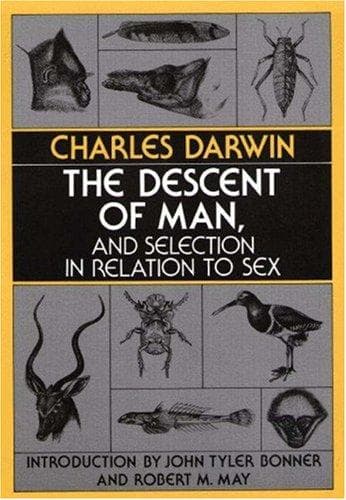
The Descent of Man, and Selection in Relation to SexDarwin, Charles
History
The Descent of Man, and Selection in Relation to Sex
Darwin, Charles
Evolution (Biology); Human beings -- Origin; Sex differences; Sexual dimorphism (Animals); Sexual selection in animals
“The three specimens of the brain of a chimpanzee, just described,
prove, that the generalisation which Gratiolet has attempted to draw of
the complete absence of the first connecting convolution and the
concealment of the second, as essentially characteristic features in
the brain of this animal, is by no means universally applicable. In
only one specimen did the brain, in these particulars, follow the law
which Gratiolet has expressed. As regards the presence of the superior
bridging convolution, I am inclined to think that it has existed in one
hemisphere, at least, in a majority of the brains of this animal which
have, up to this time, been figured or described. The superficial
position of the second bridging convolution is evidently less frequent,
and has as yet, I believe, only been seen in the brain (A) recorded in
this communication. The asymmetrical arrangement in the convolutions of
the two hemispheres, which previous observers have referred to in their
descriptions, is also well illustrated in these specimens” (pp. 8, 9).
Even were the presence of the temporo-occipital, or external
perpendicular, sulcus, a mark of distinction between the higher apes
and man, the value of such a distinctive character would be rendered
very doubtful by the structure of the brain in the Platyrrhine apes. In
fact, while the temporo-occipital is one of the most constant of sulci
in the Catarrhine, or Old World, apes, it is never very strongly
developed in the New World apes; it is absent in the smaller
Platyrrhini; rudimentary in Pithecia (73. Flower, ‘On the Anatomy of
Pithecia Monachus,’ ‘Proceedings of the Zoological Society,’ 1862.);
and more or less obliterated by bridging convolutions in Ateles.
A character which is thus variable within the limits of a single group
can have no great taxonomic value.
It is further established, that the degree of asymmetry of the
convolution of the two sides in the human brain is subject to much
individual variation; and that, in those individuals of the Bushman
race who have been examined, the gyri and sulci of the two hemispheres
are considerably less complicated and more symmetrical than in the
European brain, while, in some individuals of the chimpanzee, their
complexity and asymmetry become notable. This is particularly the case
in the brain of a young male chimpanzee figured by M. Broca. (‘L’ordre
des Primates,’ p. 165, fig. 11.)
Again, as respects the question of absolute size, it is established
that the difference between the largest and the smallest healthy human
brain is greater than the difference between the smallest healthy human
brain and the largest chimpanzee’s or orang’s brain.
Moreover, there is one circumstance in which the orang’s and
chimpanzee’s brains resemble man’s, but in which they differ from the
lower apes, and that is the presence of two corpora candicantia—the
Cynomorpha having but one.
Public-domain text, read in full here on John Shaqi.
Reviews
Reviews
No reviews yet
Be the first to share your thoughts on this work.
Elsewhere in the archive
Join the Discussion
Join the discussion
Sign in to leave a comment or review.
Sign InorCreate an account