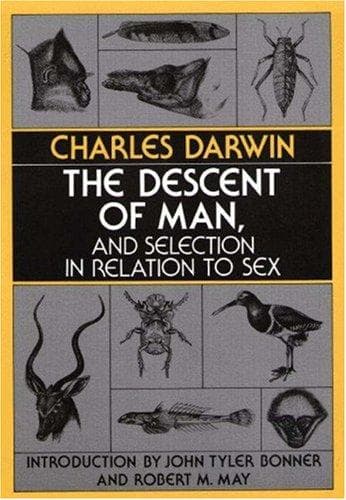
The Descent of Man, and Selection in Relation to SexDarwin, Charles
History
The Descent of Man, and Selection in Relation to Sex
Darwin, Charles
Evolution (Biology); Human beings -- Origin; Sex differences; Sexual dimorphism (Animals); Sexual selection in animals
There are many other structures and instincts which must have been
developed through sexual selection—such as the weapons of offence and
the means of defence of the males for fighting with and driving away
their rivals—their courage and pugnacity—their various ornaments—their
contrivances for producing vocal or instrumental music—and their glands
for emitting odours, most of these latter structures serving only to
allure or excite the female. It is clear that these characters are the
result of sexual and not of ordinary selection, since unarmed,
unornamented, or unattractive males would succeed equally well in the
battle for life and in leaving a numerous progeny, but for the presence
of better endowed males. We may infer that this would be the case,
because the females, which are unarmed and unornamented, are able to
survive and procreate their kind. Secondary sexual characters of the
kind just referred to, will be fully discussed in the following
chapters, as being in many respects interesting, but especially as
depending on the will, choice, and rivalry of the individuals of either
sex. When we behold two males fighting for the possession of the
female, or several male birds displaying their gorgeous plumage, and
performing strange antics before an assembled body of females, we
cannot doubt that, though led by instinct, they know what they are
about, and consciously exert their mental and bodily powers.
Just as man can improve the breeds of his game-cocks by the selection
of those birds which are victorious in the cockpit, so it appears that
the strongest and most vigorous males, or those provided with the best
weapons, have prevailed under nature, and have led to the improvement
of the natural breed or species. A slight degree of variability leading
to some advantage, however slight, in reiterated deadly contests would
suffice for the work of sexual selection; and it is certain that
secondary sexual characters are eminently variable. Just as man can
give beauty, according to his standard of taste, to his male poultry,
or more strictly can modify the beauty originally acquired by the
parent species, can give to the Sebright bantam a new and elegant
plumage, an erect and peculiar carriage—so it appears that female birds
in a state of nature, have by a long selection of the more attractive
males, added to their beauty or other attractive qualities. No doubt
this implies powers of discrimination and taste on the part of the
female which will at first appear extremely improbable; but by the
facts to be adduced hereafter, I hope to be able to shew that the
females actually have these powers. When, however, it is said that the
lower animals have a sense of beauty, it must not be supposed that such
sense is comparable with that of a cultivated man, with his multiform
and complex associated ideas. A more just comparison would be between
the taste for the beautiful in animals, and that in the lowest savages,
Public-domain text, read in full here on John Shaqi.
Reviews
Reviews
No reviews yet
Be the first to share your thoughts on this work.
Elsewhere in the archive
Join the Discussion
Join the discussion
Sign in to leave a comment or review.
Sign InorCreate an account