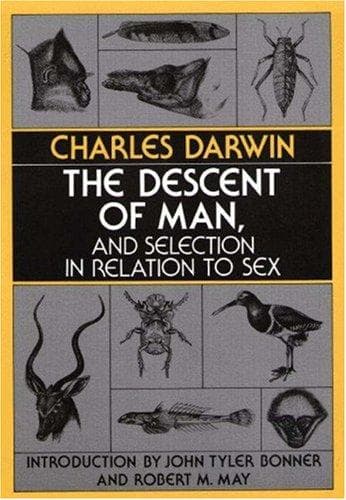
The Descent of Man, and Selection in Relation to SexDarwin, Charles
History
The Descent of Man, and Selection in Relation to Sex
Darwin, Charles
Evolution (Biology); Human beings -- Origin; Sex differences; Sexual dimorphism (Animals); Sexual selection in animals
Faye’s researches, in ‘British and Foreign Medico-Chirurg.
Review,’ April 1867, pp. 343, 345. For France, the ‘Annuaire pour l’An
1867,’ p. 213. For Philadelphia, Dr. Stockton Hough, ‘Social Science
Assoc.’ 1874. For the Cape of Good Hope, Quetelet as quoted by Dr. H.H.
Zouteveen, in the Dutch Translation of this work (vol. i. p. 417),
where much information is given on the proportion of the sexes.) The
average for Europe, deduced by Bickes from about seventy million
births, is 106 males to 100 females. On the other hand, with white
children born at the Cape of Good Hope, the proportion of males is so
low as to fluctuate during successive years between 90 and 99 males for
every 100 females. It is a singular fact that with Jews the proportion
of male births is decidedly larger than with Christians: thus in
Prussia the proportion is as 113, in Breslau as 114, and in Livonia as
120 to 100; the Christian births in these countries being the same as
usual, for instance, in Livonia as 104 to 100. (50. In regard to the
Jews, see M. Thury, ‘La Loi de Production des Sexes,’ 1863, p. 25.)
Prof. Faye remarks that “a still greater preponderance of males would
be met with, if death struck both sexes in equal proportion in the womb
and during birth. But the fact is, that for every 100 still-born
females, we have in several countries from 134.6 to 144.9 still-born
males. During the first four or five years of life, also, more male
children die than females, for example in England, during the first
year, 126 boys die for every 100 girls—a proportion which in France is
still more unfavourable.” (51. ‘British and Foreign Medico-Chirurg.
Review,’ April 1867, p. 343. Dr. Stark also remarks (‘Tenth Annual
Report of Births, Deaths, etc., in Scotland,’ 1867, p. xxviii.) that
“These examples may suffice to show that, at almost every stage of
life, the males in Scotland have a greater liability to death and a
higher death-rate than the females. The fact, however, of this
peculiarity being most strongly developed at that infantile period of
life when the dress, food, and general treatment of both sexes are
alike, seems to prove that the higher male death-rate is an impressed,
natural, and constitutional peculiarity due to sex alone.”) Dr.
Stockton Hough accounts for these facts in part by the more frequent
defective development of males than of females. We have before seen
that the male sex is more variable in structure than the female; and
variations in important organs would generally be injurious. But the
size of the body, and especially of the head, being greater in male
than female infants is another cause: for the males are thus more
liable to be injured during parturition. Consequently the still-born
males are more numerous; and, as a highly competent judge, Dr. Crichton
Browne (52. ‘West Riding Lunatic Asylum Reports,’ vol. i. 1871, p. 8.
Sir J. Simpson has proved that the head of the male infant exceeds that
Public-domain text, read in full here on John Shaqi.
Reviews
Reviews
No reviews yet
Be the first to share your thoughts on this work.
Elsewhere in the archive
Join the Discussion
Join the discussion
Sign in to leave a comment or review.
Sign InorCreate an account